A copper penny contains roughly 10²² atoms. Nobody describes a crystal by listing them.
Instead we describe one small box and the rule “repeat this forever in three directions”. The box is the unit cell, and once you can read one properly you can predict a real material’s density with a calculator and check it against a measurement.
By the end of this post you will be able to count the atoms in a unit cell without getting it wrong, compute its packing fraction, and go from a lattice parameter to a density you could verify in a lab.
In this post:
- What a unit cell is, and what it is not
- Counting atoms: the rule everyone gets wrong once
- The three cubic cells, with their numbers
- Packing fraction, derived rather than memorised
- From lattice parameter to measurable density
What a unit cell is
A crystal is a pattern repeated on a lattice — an infinite array of points, each with identical surroundings. The unit cell is the smallest box that, stacked face to face in all three directions with no gaps and no overlaps, reproduces the whole crystal.
Two clarifications that prevent most confusion.
The unit cell is not a molecule. It has no physical boundary. Nothing in a crystal of copper marks where one cell ends and the next begins; the cell is a choice we make to describe the periodicity, and you could place its origin anywhere.
The cell is not unique. Any box that tiles the lattice works. By convention we pick the one that shows the symmetry most clearly, which is why iron is described with a cube containing two atoms rather than a smaller, less symmetric cell containing one. Crystallographers distinguish the primitive cell (one lattice point, smallest possible volume) from the conventional cell (the symmetric one everyone draws) — and for body- and face-centred structures they differ.
There are exactly 14 distinct lattices in three dimensions, the Bravais lattices, grouped into seven crystal systems. Every crystalline material on Earth is built on one of those fourteen.
Counting atoms: the rule everyone gets wrong once
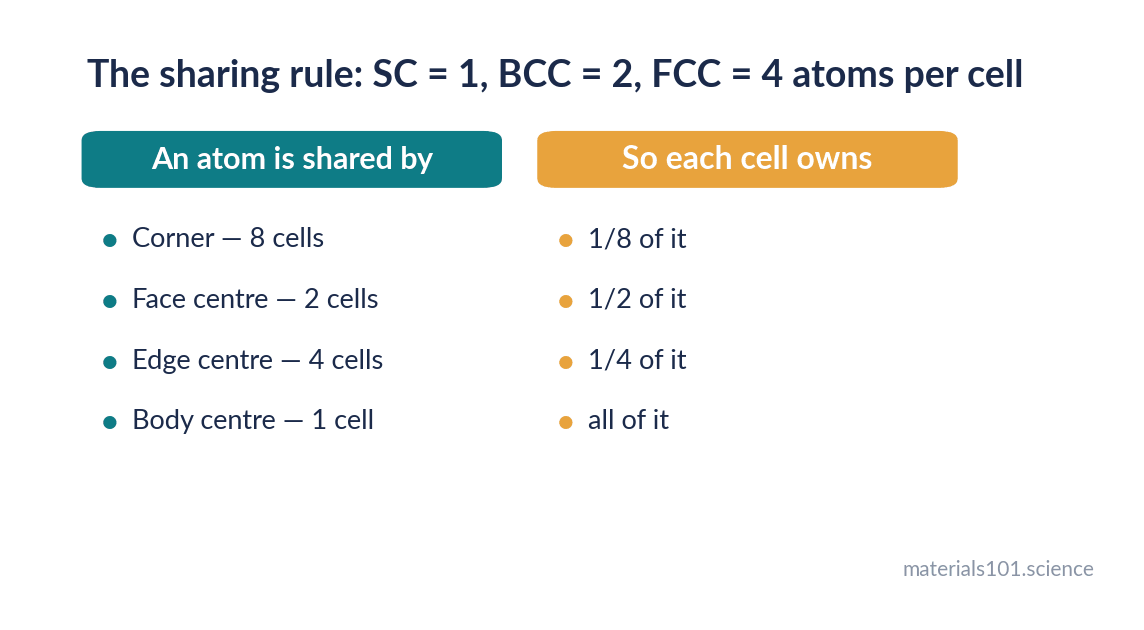
A sphere drawn at the corner of a cube does not belong to that cube. It is shared between the eight cubes meeting at that corner, so each cube owns one-eighth of it.
| Position | Shared between | Contributes |
|---|---|---|
| Corner | 8 cells | 1/8 |
| Face centre | 2 cells | 1/2 |
| Edge centre | 4 cells | 1/4 |
| Body centre | 1 cell | 1 |
Apply it to the three cubic structures:
- Simple cubic — 8 corners × 1/8 = 1 atom per cell.
- Body-centred cubic — 8 × 1/8 + 1 = 2 atoms per cell.
- Face-centred cubic — 8 × 1/8 + 6 faces × 1/2 = 4 atoms per cell.
That number, usually written n, is the one every subsequent calculation depends on. Get it wrong and your computed density will be off by a clean integer factor — which, helpfully, is the easiest kind of error to spot.
The three cubic cells
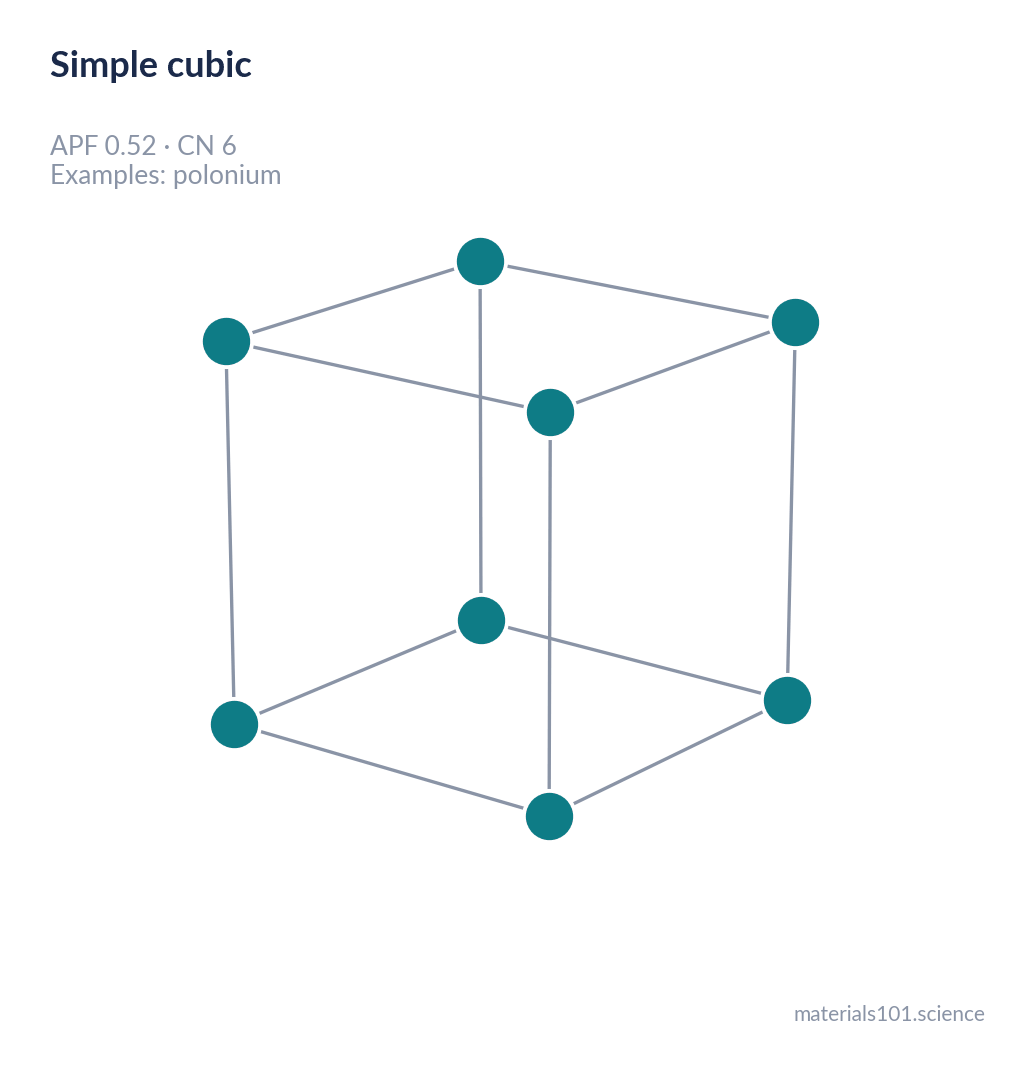
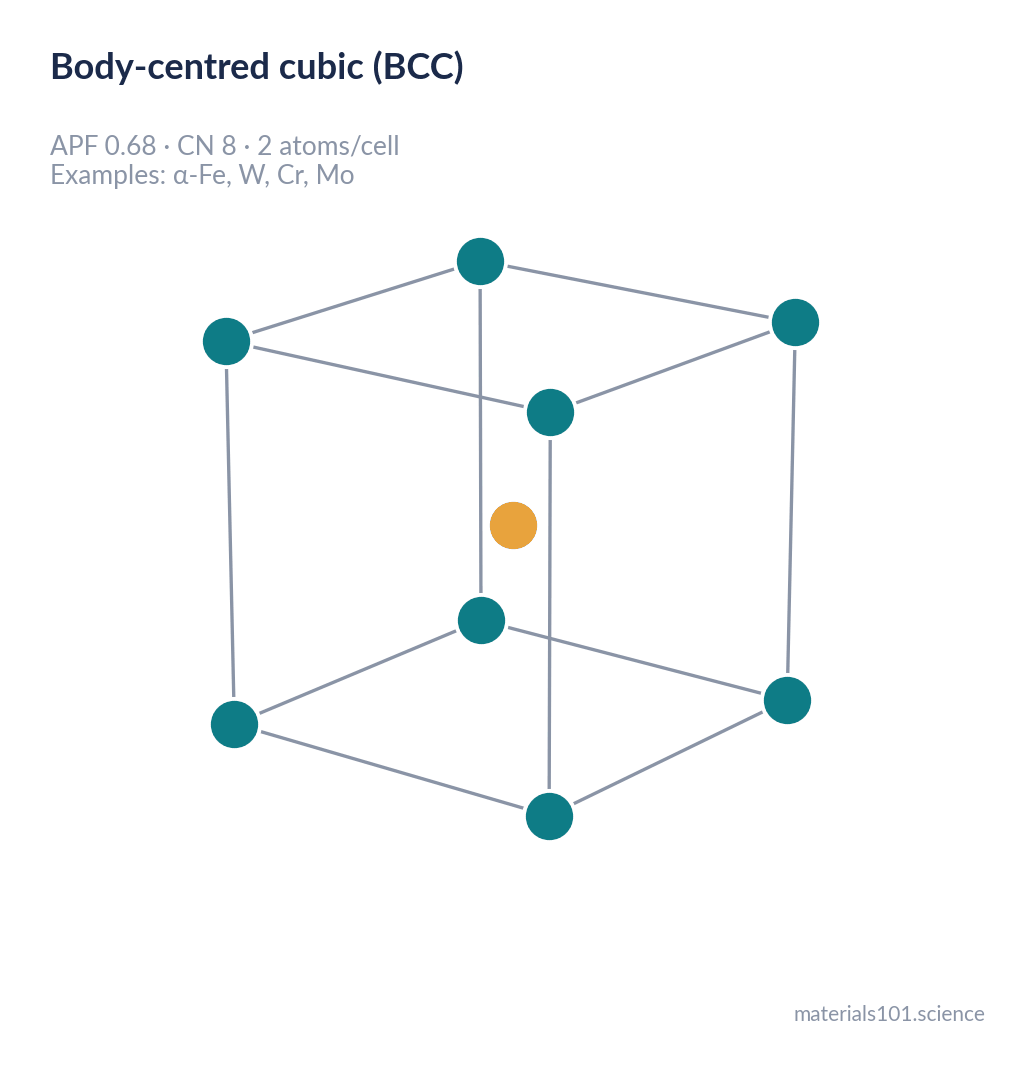
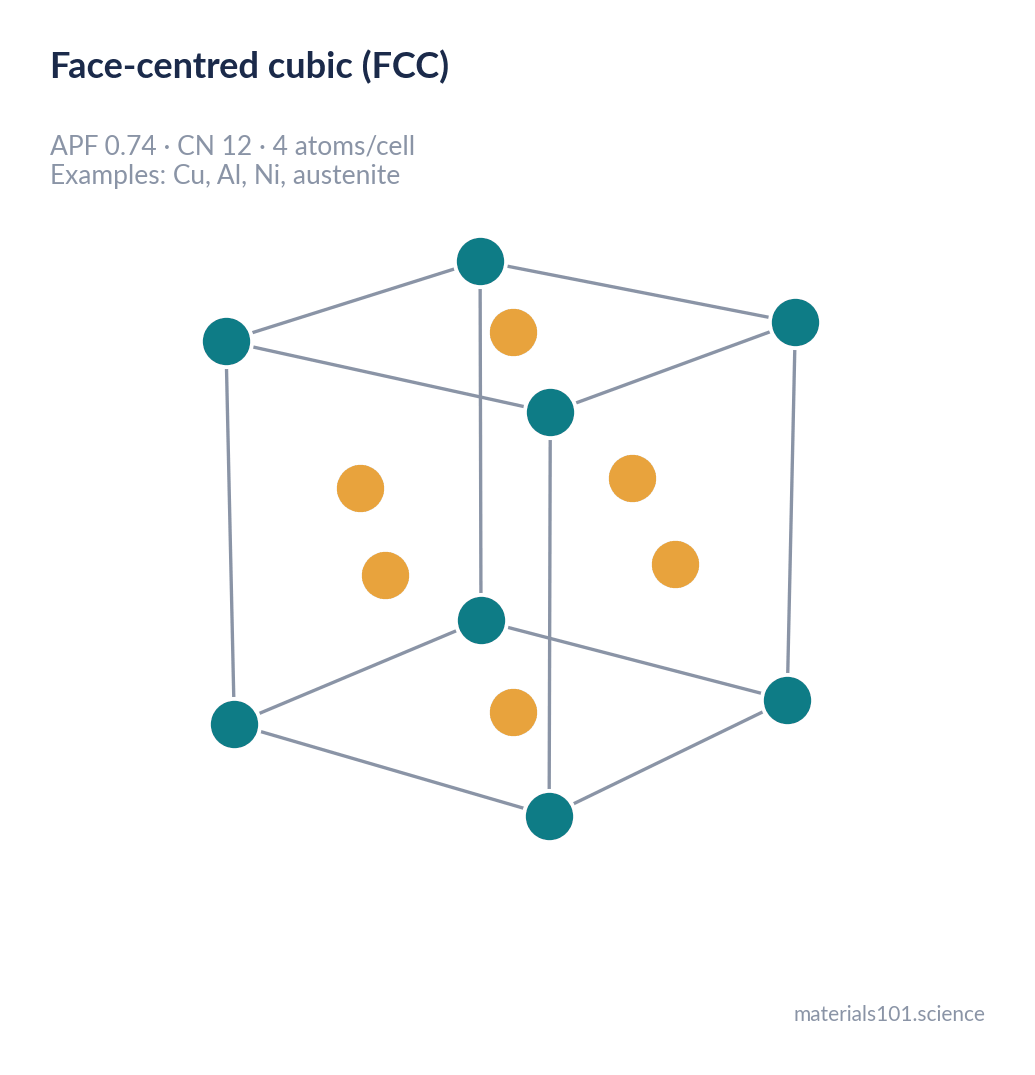
The coordination number is how many nearest neighbours each atom touches: 6 for simple cubic, 8 for BCC, 12 for FCC. It matters because it tracks how efficiently space is used, and efficiency of packing turns out to control how the metal deforms.
Packing fraction, derived rather than memorised
The atomic packing factor is the fraction of the cell’s volume actually occupied by atoms, treating them as hard spheres that touch their nearest neighbours.
APF = (n × volume of one sphere) / (volume of the cell)
The only subtlety is which direction the spheres touch along, because that sets the relationship between the atomic radius R and the lattice parameter a.
Simple cubic — spheres touch along the cube edge, so a = 2R.
APF = 1 × (4/3)πR³ / (2R)³ = π/6 = 0.5236
Body-centred cubic — spheres touch along the body diagonal, whose length is a√3 and which spans four radii, so a = 4R/√3.
APF = 2 × (4/3)πR³ / (4R/√3)³ = √3π/8 = 0.6802
Face-centred cubic — spheres touch along the face diagonal, length a√2 spanning four radii, so a = 4R/√2.
APF = 4 × (4/3)πR³ / (4R/√2)³ = π/(3√2) = 0.7405
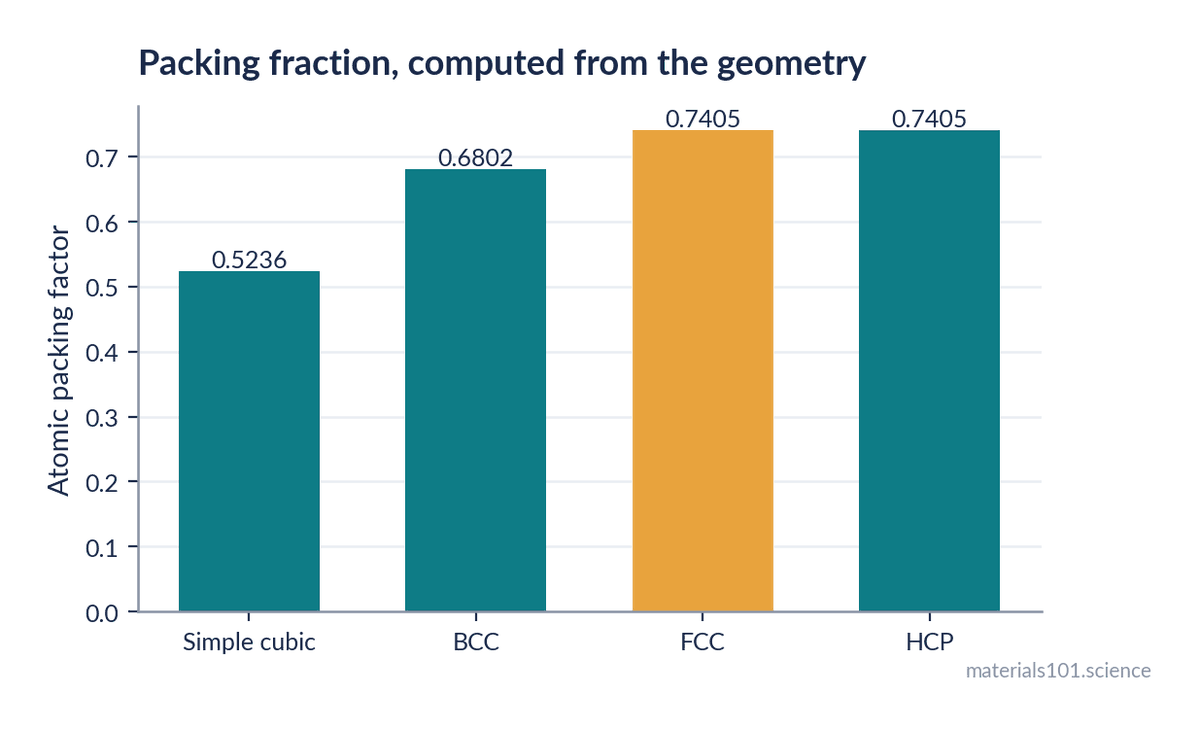
That 0.7405 is not a coincidence or a measurement. It is the maximum possible packing density for identical spheres in three dimensions, a statement conjectured by Kepler in 1611 and proved only in the late twentieth century. FCC and HCP both achieve it, which is why so many metals adopt one or the other.
Going deeper
The hard-sphere model that gives these numbers is a fiction: atoms are not hard spheres, metallic bonding is not directional, and “atomic radius” is an operational definition derived from measured interatomic distances rather than a property of a free atom. The model survives because it predicts the right ratios — which structures are denser, which have more neighbours — even though the absolute radii are conventions. Where it breaks down is instructive: covalent crystals like diamond have an APF of just 0.34, because directional bonding, not packing efficiency, sets the structure.
From lattice parameter to density
This is where the unit cell earns its place, because it connects something measured by X-ray diffraction to something measured on a balance.
ρ = n × A / (V_cell × N_A)
where n is atoms per cell, A the atomic mass in g/mol, V_cell the cell volume in cm³, and N_A Avogadro’s number.
Work it for copper. Copper is FCC, so n = 4. Its lattice parameter is a = 3.615 Å = 3.615 × 10⁻⁸ cm, and A = 63.55 g/mol.
V_cell = (3.615 × 10⁻⁸)³ = 4.723 × 10⁻²³ cm³
ρ = (4 × 63.55) / (4.723 × 10⁻²³ × 6.022 × 10²³) = 254.2 / 28.45 = 8.94 g/cm³
The handbook value for copper is about 8.96 g/cm³. Agreement to better than half a percent, from one number off a diffraction pattern and some arithmetic.
In practice
This calculation is a routine sanity check in real work. If you build a structure in pymatgen or ASE and its computed density is off by a factor of two or four from the handbook, you have almost certainly duplicated atoms at shared positions or used a primitive cell where the code expected a conventional one. It is also how you check a DFT relaxation: PBE typically overestimates lattice parameters by around 1%, which shows up as a density roughly 3% low, and knowing that in advance stops you chasing a bug that is really a known property of the functional.
Common misconceptions
- “The unit cell contains whole atoms.” Only the body-centre atom is wholly inside one cell. Corner and face atoms are shared, which is the whole point of the counting rules.
- “A bigger unit cell means a bigger atom.” No — the lattice parameter describes the repeat distance of the pattern. Some structures repeat over several atomic diameters.
- “FCC has more atoms than BCC, so it must be denser.” Atoms per cell alone tells you nothing; the cell volumes differ too. Packing fraction is the comparison that means something.
- “HCP is a different packing efficiency from FCC.” They are identical at 0.7405. The difference is the stacking sequence of close-packed layers, not how tightly they pack.
Key takeaways
- A unit cell is the smallest box that tiles space to reproduce the crystal — a description of periodicity, not a physical object.
- Atoms are shared: corners count 1/8, faces 1/2, edges 1/4, body centre 1. That gives 1, 2 and 4 atoms per cell for SC, BCC and FCC.
- Packing fractions are derived, not memorised: π/6, √3π/8 and π/(3√2), the last being the densest possible packing of equal spheres.
- Coordination number rises 6 → 8 → 12 across those three, tracking packing efficiency.
- Lattice parameter plus atoms per cell gives density to within a fraction of a percent of the measured value, which makes it an excellent check on any structure you build.
Frequently asked questions
What is a unit cell in simple terms?
It is the smallest repeating box that, stacked in all three directions, builds the entire crystal. Describing that one box and the repetition rule is enough to describe a crystal containing 10²² atoms.
How many atoms are in a unit cell?
It depends on the structure and on sharing: one for simple cubic, two for body-centred cubic, four for face-centred cubic, six for the conventional hexagonal close-packed cell. Corner atoms count as one-eighth each, face atoms as one-half.
What is the difference between a unit cell and a primitive cell?
A primitive cell contains exactly one lattice point and has the smallest possible volume. The conventional unit cell is chosen to display the symmetry clearly, so for BCC and FCC it contains two and four lattice points respectively.
Why is the atomic packing factor of FCC 0.74?
Because the spheres touch along the face diagonal, giving a = 4R/√2, and four atoms occupy the cell. The arithmetic gives π/(3√2) = 0.7405, which is provably the densest arrangement of equal spheres.
How do you calculate density from a unit cell?
ρ = nA/(V_cell N_A), with n atoms per cell, A the atomic mass, V_cell the cell volume and N_A Avogadro’s number. For copper this gives 8.94 g/cm³ against a measured 8.96.
Next read
- BCC vs FCC vs HCP: why crystal structure decides ductility — what these packing differences do to a real component
References
The packing fractions and the copper density in this post are computed from the
geometry by the figure script, not quoted; the lattice parameter and atomic mass
are standard reference values.
- W. D. Callister and D. G. Rethwisch, Materials Science and Engineering: An Introduction, 10th ed., Wiley, 2018 — unit cells, coordination numbers, packing factors, the density relation, and the copper lattice parameter used here.
- C. Kittel, Introduction to Solid State Physics, 8th ed., Wiley, 2005 — Bravais lattices, primitive versus conventional cells, close packing.
- M. De Graef and M. E. McHenry, Structure of Materials: An Introduction to Crystallography, Diffraction and Symmetry, 2nd ed., Cambridge University Press, 2012 — the fourteen Bravais lattices and the crystallographic conventions behind cell choice.
Written by Dinesh Varma, PhD scholar in computational materials science.
Spotted an error? Tell me — corrections are credited.