
When the Washington Monument was capped in 1884, the builders chose a 2.85 kg pyramid of aluminium for the apex. It was a display of wealth. Aluminium then cost more per ounce than silver, and the cap was exhibited at Tiffany’s before it was installed.
Within ten years the price had collapsed by orders of magnitude, and aluminium went from a jeweller’s curiosity to the metal we wrap sandwiches in.
Nothing was discovered in the ground. Aluminium is the most abundant metal in the Earth’s crust and always was. What changed was that two people worked out how to pay for the separation with electricity instead of chemistry.
In this post:
- Why the most common metal in the crust was once a precious one
- The two completely different processes between ore and metal
- Where the energy actually goes, with numbers
- Why smelters are built next to power stations, not next to mines
- Why recycling aluminium is so unusually worthwhile
Why abundance does not mean availability
Aluminium makes up about 8% of the crust by mass. You are never short of it. The difficulty is that it is always found bonded to oxygen, and the Al–O bond is one of the most stable in common chemistry.
That stability is the same property that makes aluminium useful. A fresh aluminium surface grows a dense oxide film within milliseconds, and that film is what stops the metal underneath from corroding. The thing that makes the metal durable in service is exactly the thing that makes it expensive to produce.
Iron oxide gives up its oxygen to carbon in a blast furnace at around 1,500 °C. Aluminium oxide does not. Carbon will not reduce it at any temperature you can build a furnace for. For most of the nineteenth century the only route was violent chemical reduction with sodium or potassium, which is why the metal cost what it did.
The two processes, and only one of them is the problem
Modern production is two entirely separate industries bolted together.
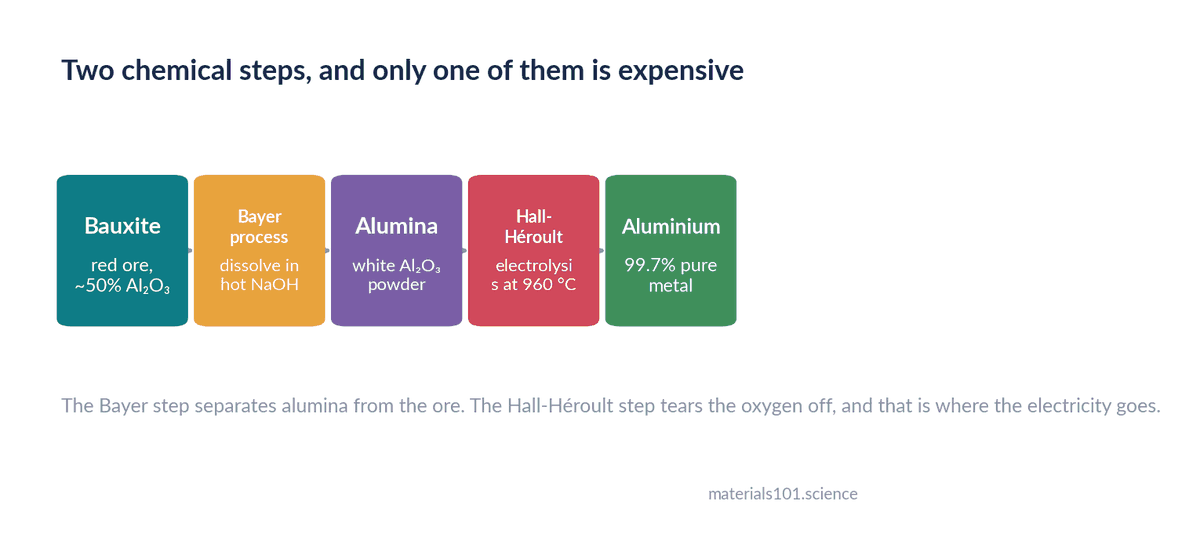
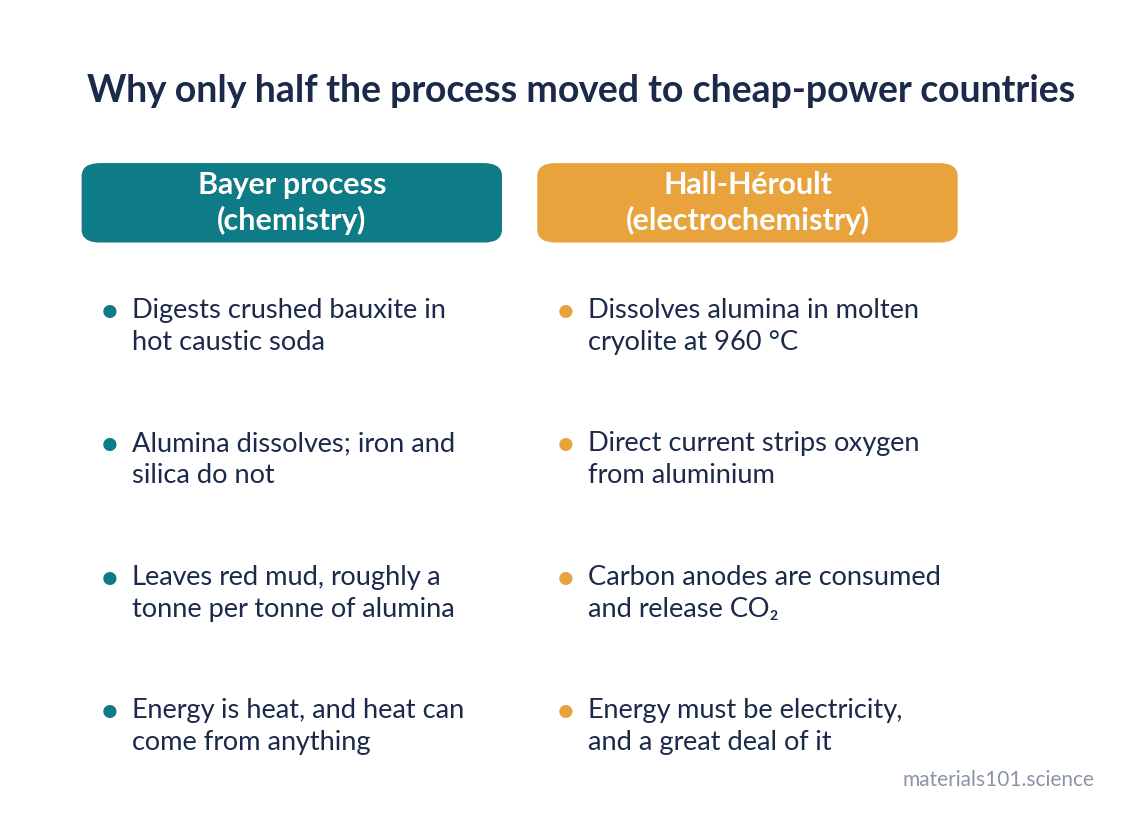
Step one, the Bayer process (1888). Crushed bauxite is digested in hot sodium hydroxide under pressure. Aluminium oxide is amphoteric — it dissolves in strong base — while the iron oxides and most silicates do not. Filter off the undissolved residue, cool and seed the liquor so aluminium hydroxide crystallises out, then calcine it to drive off water. Out comes alumina: a white powder, Al₂O₃.
The residue left behind is red mud, coloured by iron oxide and strongly caustic, and it is produced on roughly the same scale as the alumina itself. It is the industry’s most stubborn waste problem, and the 2010 Ajka dam failure in Hungary is why you may have heard of it.
Step two, the Hall–Héroult process (1886). This is the part that matters. Alumina is dissolved in molten cryolite at about 960 °C and an enormous direct current is passed through [2]. Aluminium collects as liquid metal at the cathode; oxygen goes to carbon anodes, burns them, and leaves as CO₂.
Charles Martin Hall in Ohio and Paul Héroult in France arrived at the same idea in the same year, both aged 22. Neither knew of the other.
Going deeper
The cryolite is not incidental. Alumina melts at over 2,000 °C, which would be industrially hopeless; dissolved in molten Na₃AlF₆ it becomes electrolytically accessible at around 960 °C [2]. That single solvent choice is what made the process viable, and it is why cell chemistry work still focuses heavily on the bath rather than the electrodes. The carbon anode is consumed as part of the reaction — roughly C + O²⁻ → CO₂ + 4e⁻ at the anode — so a smelter is also, unavoidably, a carbon consumer. Inert-anode research aims to replace that reaction with oxygen evolution, which would change the emissions profile of the industry more than any other single change available to it.
Where the energy goes
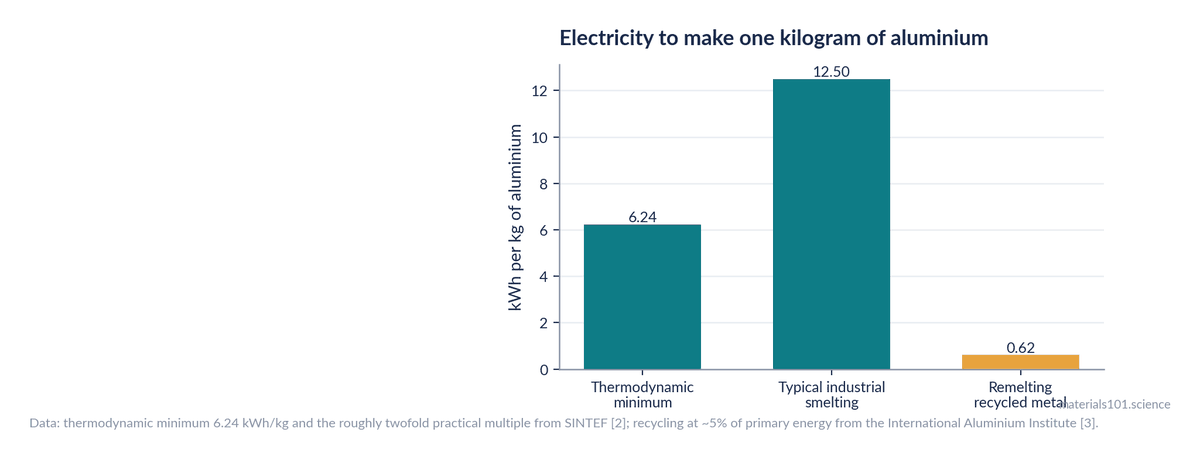
Thermodynamics sets a floor. Breaking the Al–O bonds in alumina and delivering liquid aluminium cannot, even in a perfect process with no heat loss, be done for less than 6.24 kWh per kilogram of aluminium [2].
Real cells use roughly twice that [2].
Put that in domestic terms: producing a single kilogram of primary aluminium takes something like the electricity an average household uses in half a day. A tonne takes roughly what a house uses in a year and a half.
This is why the geography of aluminium is strange. Bauxite is mined in Australia, Guinea, Brazil and India. Smelting happens in Iceland, Quebec, Norway and the Gulf — places chosen for hydroelectricity, geothermal power or stranded gas. It is cheaper to ship white powder around the planet than to move electricity to the powder.
A smelter also cannot easily be switched off. Let the bath freeze and you have a cell full of solid cryolite and a very expensive excavation job, so smelters run continuously for years. That makes them an awkward customer for intermittent renewables, and it is an active area of work.
In practice
Because the energy is overwhelmingly electrical, the carbon footprint of a tonne of aluminium depends far more on the grid that made it than on the smelter’s efficiency. The same cell technology, run on hydroelectricity in Norway or on coal power elsewhere, produces metal with completely different embodied emissions. If you are specifying aluminium and you care about carbon, the question to ask a supplier is not about the smelter — it is about the power contract.
Why recycling aluminium is unusually worthwhile
Recycling is a good idea for most materials and a spectacular one for aluminium. Remelting scrap uses around 5% of the energy of primary production [3].
The arithmetic behind that is simple: the expensive step was tearing aluminium away from oxygen, and in a piece of scrap that has already been done. You only need to melt the metal, at 660 °C, and keep it from oxidising while you do.
Aluminium also loses little in the loop. The metal does not degrade through remelting the way some polymers do; the practical limits are alloy contamination and the oxide skin lost as dross, not the aluminium itself. A large share of all the aluminium ever smelted is still in use.
Common misconceptions
“Aluminium is rare, which is why it used to be expensive.” It is the third most abundant element in the crust. It was expensive because it was hard to separate, not hard to find.
“Bauxite is aluminium ore the way iron ore is iron.” Bauxite is a mixture — mostly aluminium hydroxide minerals with iron oxides and silica. The Bayer process is a separation, not a reduction. No aluminium metal exists at any point in it.
“Smelters are near mines.” Usually the opposite. Alumina travels; cheap electricity does not.
“Recycled aluminium is lower quality.” Remelted aluminium is chemically identical. The constraint is alloy sorting — mixing a wrought alloy stream with a casting alloy stream limits what the output can be used for — which is a logistics problem, not a metallurgical one.
Key takeaways
- Aluminium is abundant but always bonded to oxygen, and that bond is too stable for carbon to break.
- Production is two unrelated processes: the Bayer process separates alumina chemically, Hall–Héroult reduces it electrically.
- The thermodynamic floor is 6.24 kWh/kg and industry runs at about twice that [2].
- Smelters follow cheap electricity, not ore, because only the electrolysis step demands electricity specifically.
- Recycling uses about 5% of primary energy [3], because the reduction never has to be paid for twice.
Frequently asked questions
How is aluminium extracted from bauxite?
In two stages. The Bayer process digests bauxite in hot caustic soda to dissolve and recrystallise pure alumina, Al₂O₃. The Hall–Héroult process then dissolves that alumina in molten cryolite at about 960 °C and passes a direct current through it, depositing aluminium metal [2].
Why can’t aluminium be smelted like iron?
Because carbon cannot reduce aluminium oxide at practical temperatures. The Al–O bond is far more stable than the Fe–O bond, so a blast furnace, which works by letting carbon take oxygen from iron, does nothing useful to alumina.
How much electricity does aluminium smelting use?
About twice the thermodynamic minimum of 6.24 kWh per kilogram of aluminium [2] — of the order of 12–13 kWh/kg in a typical modern cell.
What is red mud?
The insoluble residue from the Bayer process: iron oxides, silica, titania and residual caustic soda. It is produced on roughly the same scale as the alumina and is highly alkaline, which makes its storage the industry’s hardest environmental problem.
Is recycled aluminium as good as new?
Chemically, yes. The limitation is keeping alloy families separate during collection, because mixed scrap can only be used for less demanding alloys.
Next read
- BCC vs FCC vs HCP: why crystal structure decides ductility — aluminium is FCC, and that is why it forms so well
- Annealing vs normalizing vs tempering
Spotted an error? Tell me — corrections are made in public.
References
- Historical pricing and the Washington Monument apex are standard accounts in the history of the aluminium industry.
- SINTEF, Aluminium production — the Hall–Héroult process. Theoretical minimum of 6.24 kWh/kg Al, practical consumption at approximately twice that, and the 960 °C cryolite bath. https://blog.sintef.com/?p=13145
- International Aluminium Institute, Aluminium recycling saves 95% of the energy needed for primary aluminium production. https://international-aluminium.org/landing/aluminium-recycling-saves-95-of-the-energy-needed-for-primary-aluminium-production/