
Gold melts at 1064 °C. Everyone knows this, and it is printed in every handbook.
It is also only true for gold you can see. Make the particle small enough — a couple of nanometres, a few hundred atoms — and it melts hundreds of degrees lower. Same element, same crystal structure, same bonds. A different number.
Nothing mysterious is happening. Three mechanisms explain almost every “anomalous” nanoscale property, and the first one explains most of them by itself.
In this post:
- The arithmetic that drives everything
- Melting point depression, with the equation
- Why nanoparticle catalysts work
- Quantum confinement, and where it actually applies
- What does not change
The arithmetic that drives everything
Take a cube of side L. Its volume is L³ and its surface area is 6L². The ratio of surface to volume is 6/L — so as L shrinks, the ratio grows without limit.
That is the whole story, and it is worth making concrete. What fraction of the atoms in a particle are at the surface?
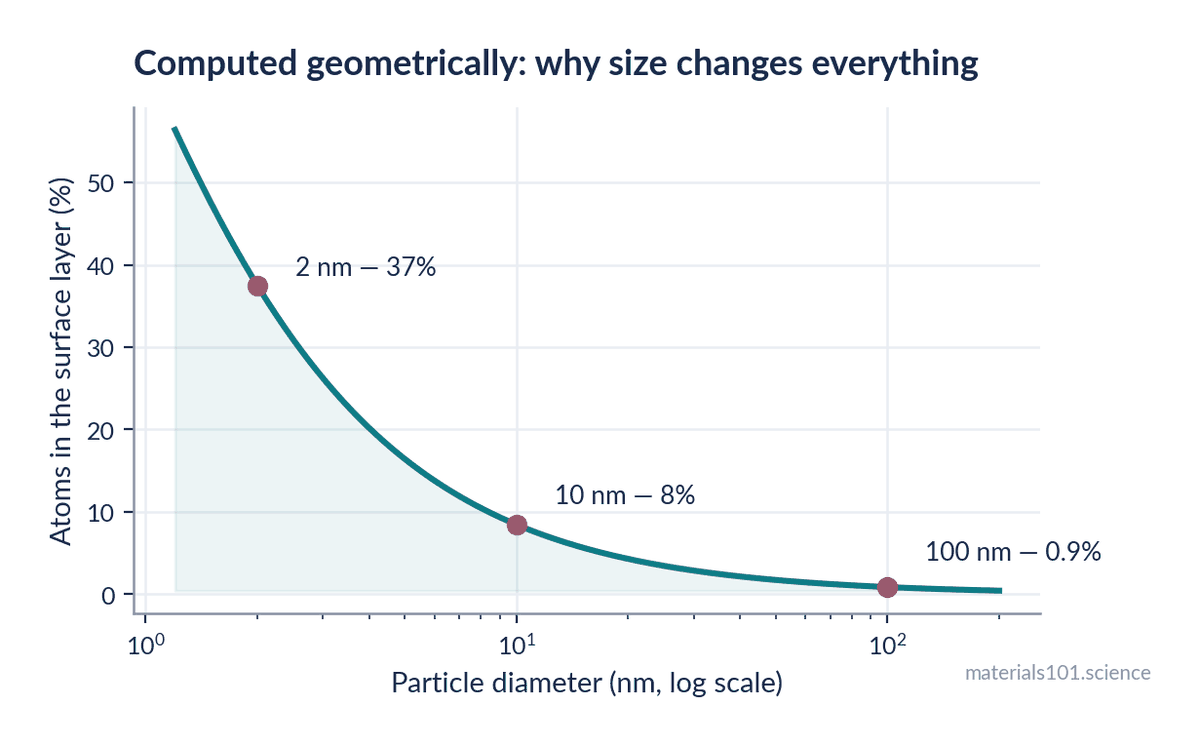
At 100 nanometres, about 0.9% of atoms sit in the outermost atomic layer. At 10 nm it is 8%. At 2 nm it is 37% — better than a third of the entire particle.
A surface atom is a different object from an interior atom. It has fewer neighbours, so it is less strongly bound; it carries unsatisfied bonding, which is what surface energy measures; and it is freer to move. When more than a third of your material consists of these atoms, bulk properties — measured on material where surface atoms were negligible — stop applying.
This is not a new law of physics. It is the same physics with a term that used to be ignorable suddenly dominating.
Melting point depression, with the equation
Melting starts at surfaces, because surface atoms are the least constrained. In a bulk crystal the surface is a vanishing fraction of the whole, so this barely matters. In a nanoparticle, it sets the melting point.
The relationship is the Gibbs-Thomson equation, which in its simplest form reads
T_m(d) = T_m,bulk × (1 − C/d)
where d is the particle diameter and C collects the surface energy, the latent heat of fusion and the density. For gold, C works out to a few nanometres, which means the depression becomes severe below about 10 nm.
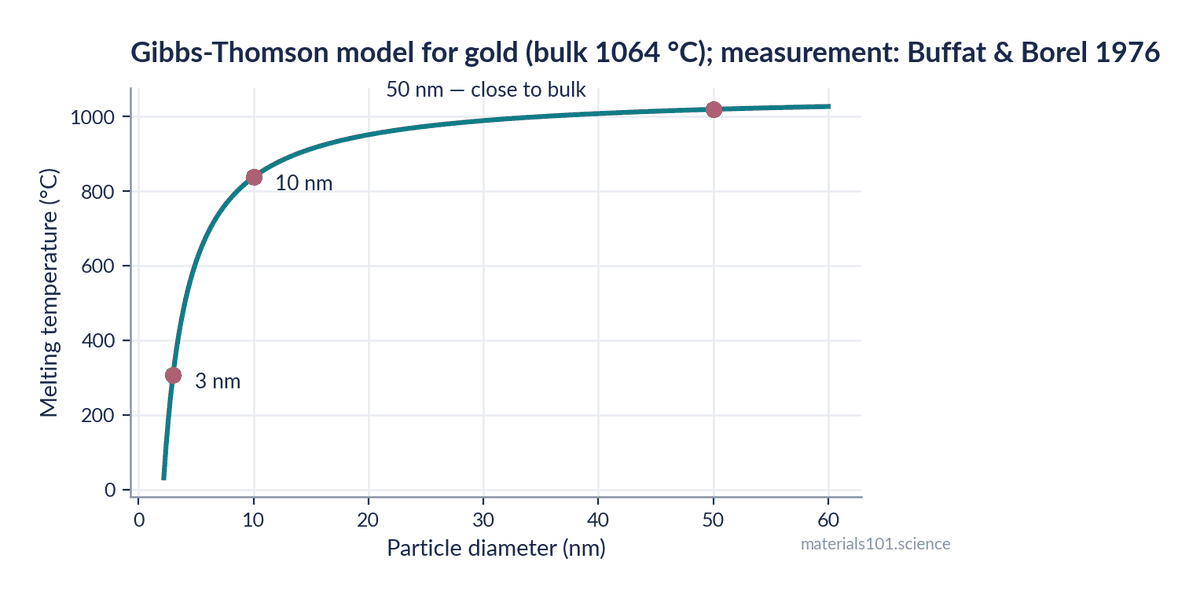
Buffat and Borel established this experimentally for gold in 1976, using electron diffraction on particles down to a couple of nanometres [1]. It is one of those papers that is still cited constantly fifty years later, because it settled the question cleanly.
The consequence in the lab is that nanoparticles sinter. Two particles in contact at a temperature far below the bulk melting point will merge and coarsen, because their surface atoms are mobile. This is exactly why nanoparticle catalysts degrade in service, and why so much catalyst engineering is really anti-sintering engineering.
Going deeper
The Gibbs-Thomson relation as written assumes a spherical particle with isotropic surface energy and a sharp solid-liquid interface, and it diverges as d approaches C. Real particles are faceted, so surface energy is anisotropic and the low-index facets melt last; below about 2 nm the concept of a melting temperature starts to break down entirely, because the particle has so few atoms that the transition is broad rather than sharp and the system spends measurable time fluctuating between ordered and disordered states. The equation is an excellent guide from roughly 50 nm down to 3 nm, and a qualitative one below that.
Why nanoparticle catalysts work
Catalysis happens on surfaces, so the surface-to-volume argument is directly a catalysis argument — but it is not only about having more surface per gram.
More surface per gram. Dividing 1 gram of platinum into 2 nm particles rather than 2 µm particles multiplies the available surface roughly a thousandfold. That alone justifies the expense.
Different sites. Small particles are dominated by edges, corners and low-coordination sites, which bind reactants differently from the flat terraces of a large crystal. Catalytic activity per surface atom can therefore change with particle size — sometimes non-monotonically, with a peak at a particular diameter. This is why catalyst papers report size distributions so carefully: the average diameter is a control variable, not a description.
Altered electronic structure. Below a few nanometres the d-band of a transition metal narrows because atoms have fewer neighbours, which shifts adsorption energies. That is a real effect and it is why 2 nm gold is catalytically active while bulk gold is famously inert.
Quantum confinement, and where it actually applies
This is the mechanism most often invoked and most often misapplied.
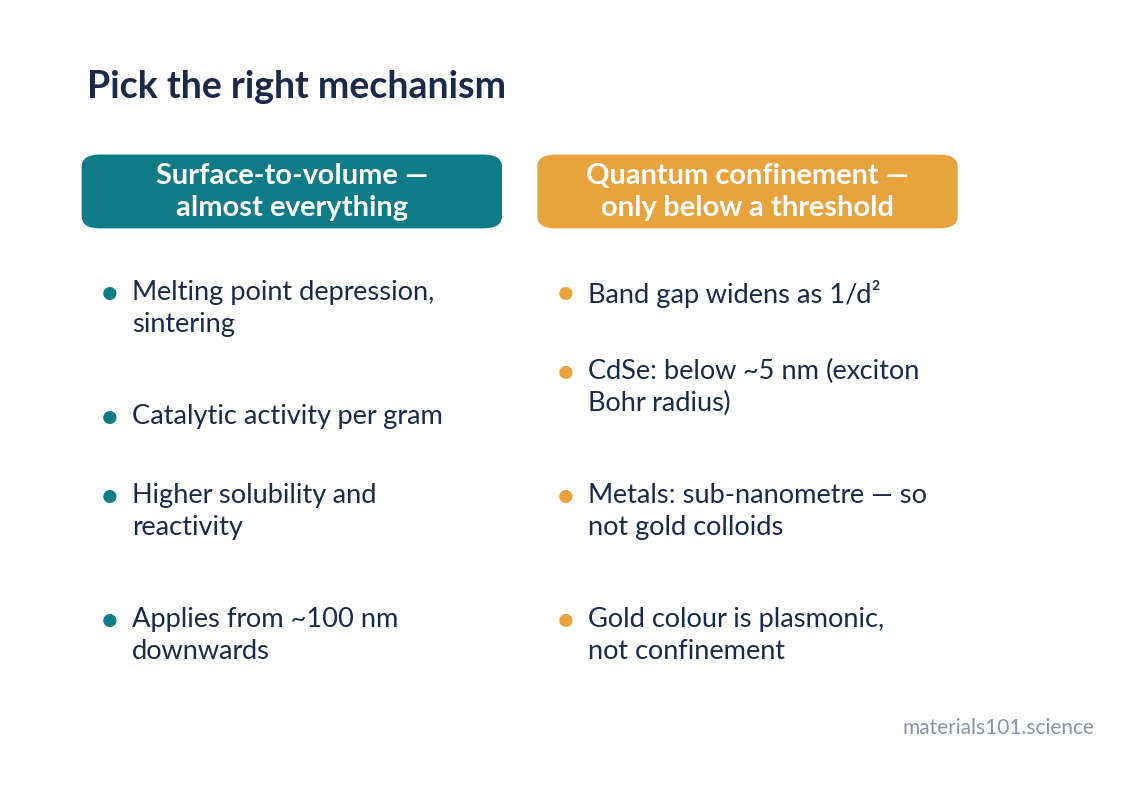
When a particle becomes comparable in size to the wavelength of the electron states it hosts, those states become quantised by the boundaries — a particle-in-a-box effect. The band gap widens as the particle shrinks, roughly as 1/d².
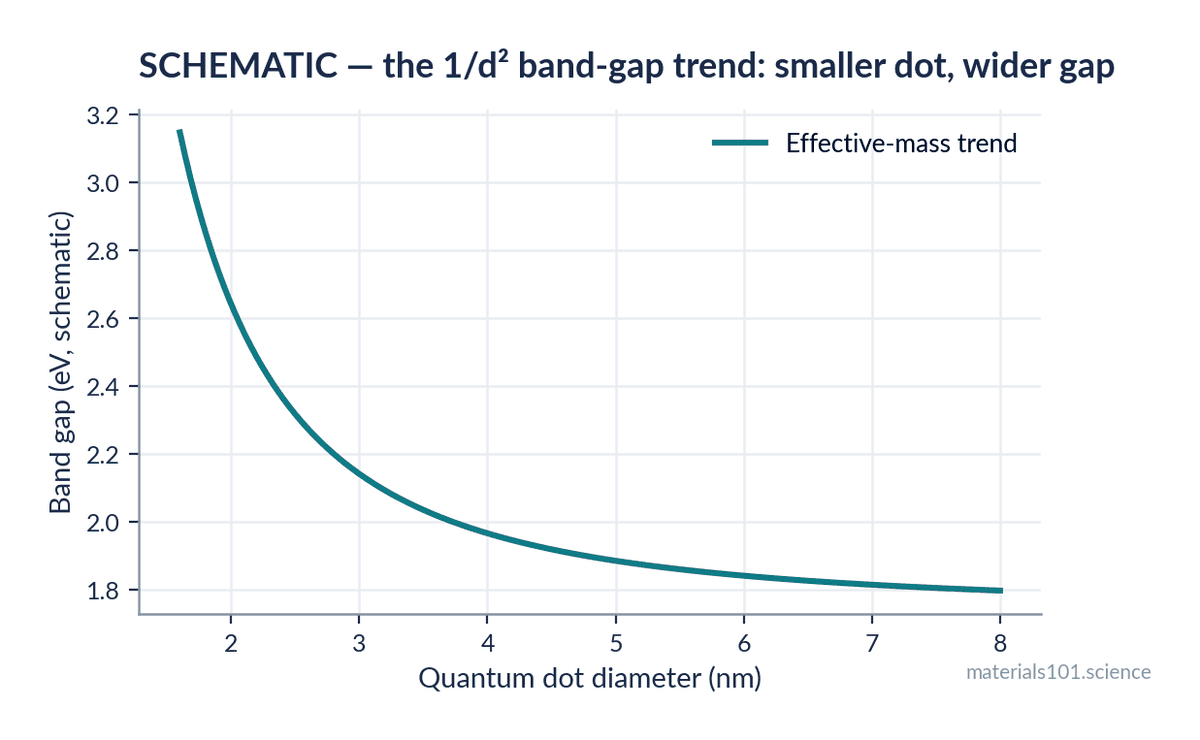
The visible consequence is colour. A cadmium selenide quantum dot of 2 nm fluoresces blue; the same material at 6 nm fluoresces red. One composition, one crystal structure, a tunable emission wavelength — which is what put quantum dots in television displays and in cell imaging.
The important caveat: confinement matters when the particle is smaller than the material’s exciton Bohr radius, which is a material property. In CdSe that is around 5 nm, so quantum dots of a few nanometres are strongly confined. In a metal, the relevant length is the Fermi wavelength, which is a fraction of a nanometre — so a 5 nm gold particle is not quantum confined in any useful sense. Gold nanoparticle colour comes from something else entirely: a plasmon resonance, a collective oscillation of conduction electrons, whose frequency depends on particle size and shape and on the surrounding medium.
Calling the red colour of a gold colloid “quantum confinement” is a common and wrong explanation. It is plasmonics, and the distinction matters because the two scale differently with size.
What does not change
Worth stating plainly, because the hype runs the other way.
The crystal structure usually does not change. A 5 nm gold particle is still FCC with essentially the bulk lattice parameter, though very small particles show slight lattice contraction from surface stress.
The chemistry does not change. Gold is still gold. It does not acquire new oxidation states because it is small.
Bonding is not different. The same metallic bonding, the same interatomic potential. Only the proportion of atoms in low-coordination environments changes.
That is why nanoscience is an extension of materials science rather than a separate subject. The tools are the same; what changes is which term in the free energy dominates.
In practice
Two consequences that decide whether nanomaterial work succeeds. Nanoparticles are thermodynamically unstable against coarsening — high surface area is high surface energy, and the system will reduce it if you let it. Anything that must survive at temperature needs stabilisation: a support, a ligand shell, or a core-shell structure. And characterisation must report the distribution, not the mean. A sample described as “10 nm particles” that is actually 5–40 nm behaves like its large tail for sintering and its small tail for optical properties, and a single number hides both.
Common misconceptions
- “Nanoparticles obey different physics.” Same physics. The surface term stops being negligible, and quantum effects appear only below material-specific length scales.
- “Gold nanoparticles are red because of quantum confinement.” They are red because of a plasmon resonance. Gold is not quantum confined at those sizes.
- “Smaller is always better for catalysis.” Activity per atom often peaks at a particular size, and smaller particles sinter faster. The optimum is a compromise.
- “Nanoparticles have a lower melting point because they have less material to heat.” That is heat capacity, not melting point. The depression is thermodynamic and comes from surface energy.
Key takeaways
- Surface-to-volume scales as 1/d: about 0.9% of atoms are in the surface layer at 100 nm, 8% at 10 nm and 37% at 2 nm — that single fact explains most nanoscale behaviour.
- Melting point depression follows the Gibbs-Thomson relation and is severe below about 10 nm; it is also why nanoparticles sinter far below bulk melting temperatures.
- Catalytic behaviour changes through three routes: more surface per gram, a different mix of surface sites, and a narrowed d-band.
- Quantum confinement applies only below a material’s exciton Bohr radius — real for CdSe quantum dots, not for gold nanoparticles, whose colour is plasmonic.
- Crystal structure, chemistry and bonding do not change. The balance of energy terms does.
Frequently asked questions
Why do nanoparticles behave differently from bulk material?
Because the fraction of atoms at the surface becomes large. Surface atoms have fewer neighbours, are less strongly bound and carry unsatisfied bonding, so when they make up a significant fraction of the particle they dominate properties that bulk measurements attribute to the interior.
Why do nanoparticles melt at a lower temperature?
Melting begins at surfaces, and a nanoparticle is mostly surface. The Gibbs-Thomson relation gives the depression as roughly proportional to 1/diameter, so it becomes severe below about 10 nm — gold particles of a couple of nanometres melt hundreds of degrees below the bulk 1064 °C.
What is the difference between quantum confinement and plasmon resonance?
Quantum confinement quantises electronic states when the particle is smaller than the exciton Bohr radius, widening the band gap — that is what makes quantum dots tunable. A plasmon resonance is a collective oscillation of conduction electrons in a metal particle, and it is what gives gold colloids their colour.
At what size do nanoscale effects start?
Surface effects grow continuously and become practically important below roughly 100 nm, and dominant below 10 nm. Quantum confinement has a material-specific threshold — around 5 nm for CdSe, and sub-nanometre for metals.
Do nanoparticles have a different crystal structure?
Generally no. A 5 nm gold particle is still FCC with close to the bulk lattice parameter, although surface stress causes slight lattice contraction in very small particles and some materials do adopt different structures at extremely small sizes.
Next read
- What is a unit cell? — the bulk crystallography this post departs from
- BCC vs FCC vs HCP: why crystal structure decides ductility — what packing does in bulk material
References
Figure 1 is computed geometrically by this post’s figure script. Figure 2 plots
the Gibbs-Thomson model, not measured points, and says so; figure 4 is a labelled
schematic.
- Ph. Buffat and J.-P. Borel, Size effect on the melting temperature of gold particles, Physical Review A 13, 2287–2298 (1976). doi:10.1103/PhysRevA.13.2287 — the measurement of melting point depression in gold that the model curve describes.
- W. D. Callister and D. G. Rethwisch, Materials Science and Engineering: An Introduction, 10th ed., Wiley, 2018 — surface energy, bulk property reference values.
- C. Kittel, Introduction to Solid State Physics, 8th ed., Wiley, 2005 — Fermi wavelength, plasmons, electronic structure of metals.
- L. E. Brus, Electron–electron and electron-hole interactions in small semiconductor crystallites: The size dependence of the lowest excited electronic state, The Journal of Chemical Physics 80, 4403–4409 (1984). doi:10.1063/1.447218 — the effective-mass treatment of quantum confinement behind the 1/d² trend.
Written by Dinesh Varma, PhD scholar in computational materials science.
Spotted an error? Tell me — corrections are credited.