A stainless steel sink and a cast iron pan are both mostly iron. Leave both wet overnight and one is unchanged while the other has gone orange.
The usual explanation is that stainless steel does not rust. That is not what happens. Stainless steel oxidises the instant it meets air — faster, in fact, than plain steel does.
The difference is entirely in what the oxide turns out to be like.
In this post:
- Why rust destroys steel but chromium oxide protects it
- What the passive layer actually is, and how thin
- Why 316 costs more than 304, and exactly what you get
- The three ways stainless steel does fail
- Why a weld can turn stainless steel back into ordinary steel
Rust is a bad oxide
Iron oxide is a poor protective layer for a reason you can see on any neglected gate: it flakes.
The oxide occupies more volume than the iron it replaced, so as it grows it builds stress against the metal beneath, cracks, and spalls away. Each flake that falls off exposes clean metal, which promptly oxidises in turn. Corrosion never slows down. Given water and oxygen, the reaction runs until there is nothing left to react.
Chromium oxide behaves completely differently. Add enough chromium to steel — the conventional threshold is 10.5% — and the oxide that forms is a chromium-rich film that is dense, tightly bonded to the metal, and continuous.
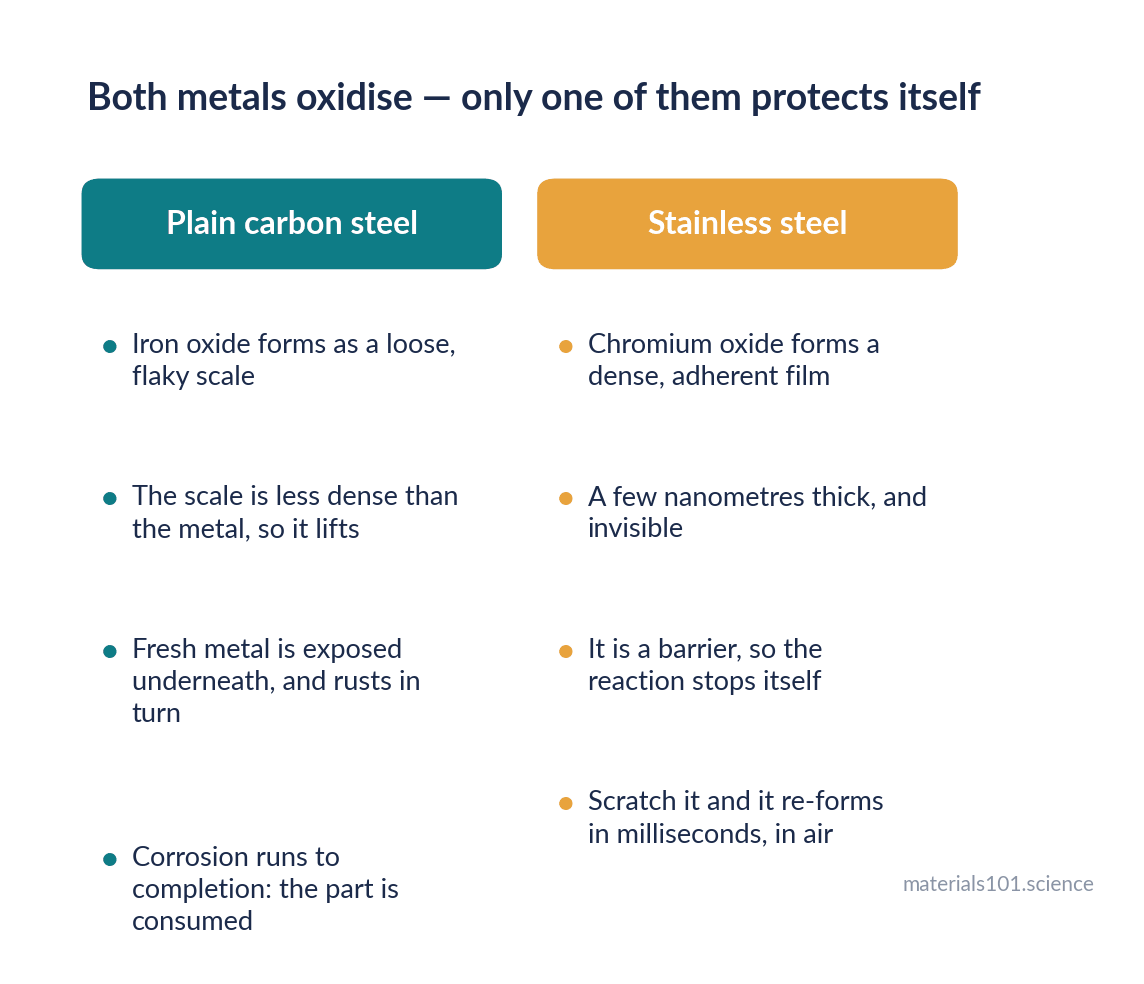
Once that film covers the surface, oxygen can no longer reach the metal. The reaction stops because it has sealed itself off. This condition is called passivity, and the film is the passive layer.
Two nanometres
The passive layer is typically a few nanometres thick — of the order of a hundredth of the wavelength of visible light, which is why it is perfectly transparent and stainless steel looks like bare metal.
The useful property is not the thickness. It is the speed of repair. Scratch a stainless surface with a knife and you expose fresh metal; in air, the film re-forms over the scratch essentially immediately. The material does not need maintenance, coating or inspection to stay protected, which is the real reason it is worth the alloy cost.
This self-repair has a requirement that gets forgotten: it needs oxygen. Stainless steel in free air or aerated water repassivates constantly. Stainless steel sealed inside a crevice, under a gasket, beneath a deposit, or in stagnant oxygen-depleted water cannot repair its film. That is the origin of crevice corrosion, and it is why stainless fasteners fail in the gap rather than on the open face.
Going deeper
Passivity is an electrochemical state rather than merely a physical coating, and the distinction matters when you read a polarisation curve. Sweep the potential of a stainless steel upward in acid and the current first rises (active dissolution), then collapses by orders of magnitude as the film forms (the passive plateau), then rises again at high potential as the film breaks down (transpassive dissolution). An alloy is only “stainless” within the potential and pH window where that plateau exists. Chloride contracts the window; molybdenum widens it. This is also why cathodic protection, which helps carbon steel, can actively harm stainless steel if it drives the potential out of the passive range.
What the molybdenum buys
The headline weakness of the passive film is the chloride ion. Chloride is small, aggressive and specifically good at finding weak points in the film, breaking through at a single site and attacking the metal underneath while the surrounding surface stays perfectly passive. The result is pitting: a deep, narrow hole in an otherwise pristine sheet.
Pitting is dangerous precisely because it is localised. A pit can perforate a wall while the component still looks new and has lost a negligible fraction of its mass.
Molybdenum makes pitting much harder to start and much easier to repassivate once started. That, in one word, is the difference between 304 and 316.
The industry compares grades with the pitting resistance equivalent number:
PREN = %Cr + 3.3 × %Mo + 16 × %N [2]
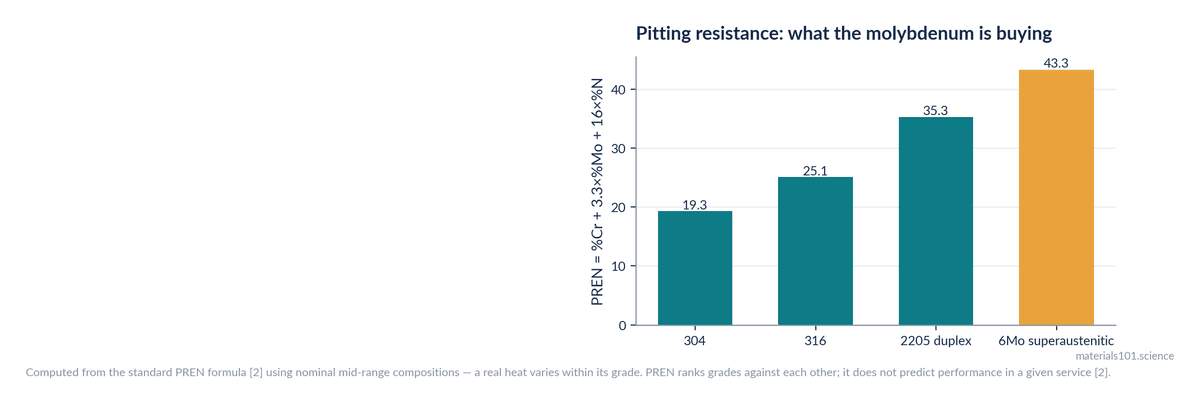
Two percent of molybdenum lifts 316 from about 19 to about 25. Duplex grades reach the mid-30s on a combination of all three elements, and 6Mo superaustenitics go past 40 — which is roughly what seawater handling demands.
In practice
The commonest specification error is treating “stainless” as a single material. 304 in a coastal atmosphere, a swimming pool hall, or anywhere de-icing salt reaches will pit, and it will do so while looking fine from a distance. If chlorides are present, the question is not whether to use stainless steel but which PREN you need — and if the answer is a chloride-rich warm environment under tension, you should also be asking about stress corrosion cracking, which austenitic grades are notably bad at and duplex grades much better.
Three ways it fails
Pitting, as above: chloride attack at discrete sites.
Crevice corrosion: the same chemistry, but in a geometry where oxygen cannot resupply the film. Under washers, inside threaded joints, beneath marine growth. Design is the defence — avoid the crevice, or seal it properly.
Sensitisation: the one that catches people out, because it is self-inflicted.
Hold an austenitic stainless steel in roughly the 450–850 °C range — as happens in the heat-affected zone either side of a weld — and chromium carbides precipitate on the grain boundaries. Carbon is a minor alloying element, but chromium carbide is mostly chromium, and it has to take that chromium from the metal immediately around the boundary.
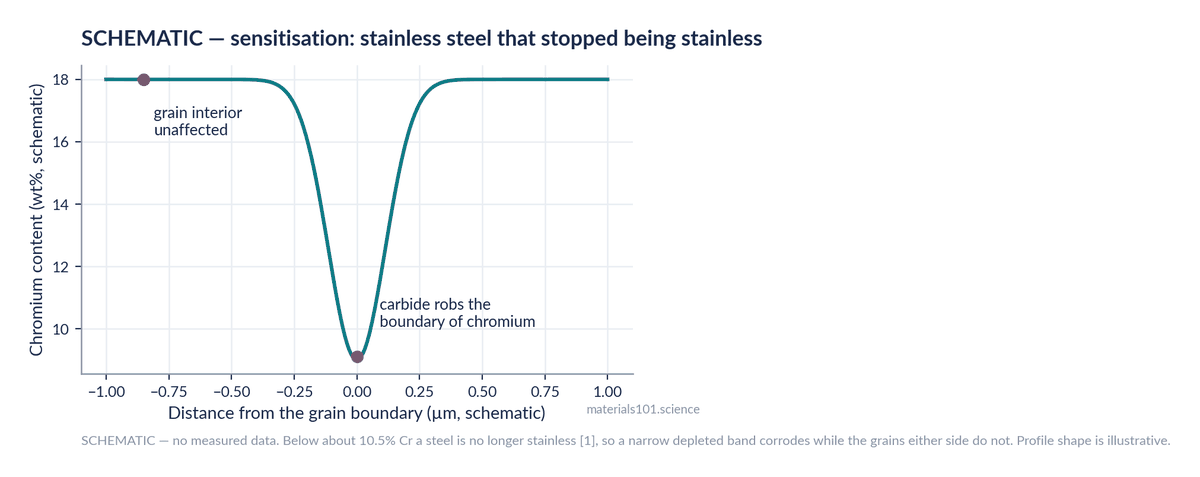
The fix is to deny the carbides their carbon. L grades such as 304L and 316L cap carbon at around 0.03%, so there is too little to precipitate meaningfully. Stabilised grades such as 321 and 347 add titanium or niobium, which grab the carbon first and leave the chromium in solution. This is why welded pipework is specified in L grades almost by reflex.
Common misconceptions
“Stainless steel cannot rust.” It can. Free iron contamination — from a carbon steel wire brush, or grinding dust — will rust on the surface and can break down the film beneath. This is why stainless fabrication uses dedicated tools.
“316 is just better than 304.” It is better in chlorides specifically. In clean indoor environments 304 performs identically and costs less. Paying for molybdenum you do not need is as much a specification error as omitting it.
“The shiny finish is the protection.” The passive film is invisible and forms regardless of finish. A smoother finish helps by giving deposits and chlorides fewer places to settle, but polishing is not what makes it stainless.
“Magnetic means it isn’t stainless.” Ferritic and martensitic stainless grades are magnetic and perfectly stainless. Austenitic grades are nominally non-magnetic but can become slightly magnetic after cold work.
Key takeaways
- Stainless steel oxidises continuously; it survives because chromium oxide is dense, adherent and self-sealing.
- The threshold is about 10.5% chromium, and the film is only a few nanometres thick.
- Repassivation needs oxygen, which is why crevices and stagnant water are where stainless fails.
- Molybdenum buys pitting resistance; PREN = %Cr + 3.3%Mo + 16%N ranks grades [2].
- Welding can sensitise a steel by precipitating chromium carbides at grain boundaries; L and stabilised grades exist to prevent it.
Frequently asked questions
Why doesn’t stainless steel rust?
It does corrode, but the corrosion product is a chromium-rich oxide film a few nanometres thick that is dense and adherent enough to block oxygen from reaching the metal. The reaction seals itself off, and the film re-forms within moments if damaged.
How much chromium does stainless steel need?
At least about 10.5%, the conventional threshold for a continuous passive film to form.
What is the difference between 304 and 316?
Roughly two percent molybdenum, which raises the pitting resistance equivalent number from about 19 to about 25 and makes 316 substantially more resistant to chloride pitting. In chloride-free environments the two behave much the same.
Can stainless steel rust in seawater?
304 and 316 both pit in seawater, 316 more slowly. Sustained seawater service generally calls for a PREN above roughly 40 — duplex, superduplex or 6Mo superaustenitic grades.
What is sensitisation?
Chromium carbide precipitation at grain boundaries between about 450 and 850 °C, which leaves a chromium-depleted band next to each boundary. That band is no longer stainless, so corrosion attacks along the grain boundary network. Low-carbon L grades and stabilised grades prevent it.
Next read
- Reading the iron-carbon phase diagram in 10 minutes
- Annealing vs normalizing vs tempering
- BCC vs FCC vs HCP: why crystal structure decides ductility
Spotted an error? Tell me — corrections are made in public.
References
- The 10.5% chromium threshold is the conventional definition of a stainless steel, used in the EN 10088 family of standards.
- Langley Alloys, Pitting Resistance Equivalent Number. PREN = %Cr + 3.3×%Mo + 16×%N; ~25 for 316L and ~34 for 2205; and the caution that PREN ranks grades rather than predicting service performance. https://www.langleyalloys.com/pitting-resistance-equivalent-number-30/