
A student once told me his part had been “annealed to increase hardness”. It is a completely reasonable mistake, because all three of these treatments involve heating steel up and cooling it down, and the textbook descriptions blur into one another.
They are not variations of one process. They have different goals, different cooling rates, and only one of them requires the steel to have been quenched first.
By the end of this post you will be able to say which of the three a part needs from a description of the problem, and explain what each one does to the microstructure.
In this post:
- The two temperatures everything hangs off
- What each treatment actually does
- The schedules, side by side
- How to choose, and the four common mistakes
- Where the others fit: stress relief, spheroidizing, austempering
The two temperatures everything hangs off
Every steel heat treatment is defined relative to two lines on the iron-carbon diagram.
A₁ = 727 °C is the eutectoid temperature. Below it, no austenite exists in a plain carbon steel, whatever the carbon content. A₃ is the line above which a hypoeutectoid steel is fully austenite, and it depends on carbon: 912 °C for pure iron, falling to 727 °C at the eutectoid composition of 0.76 wt% C.
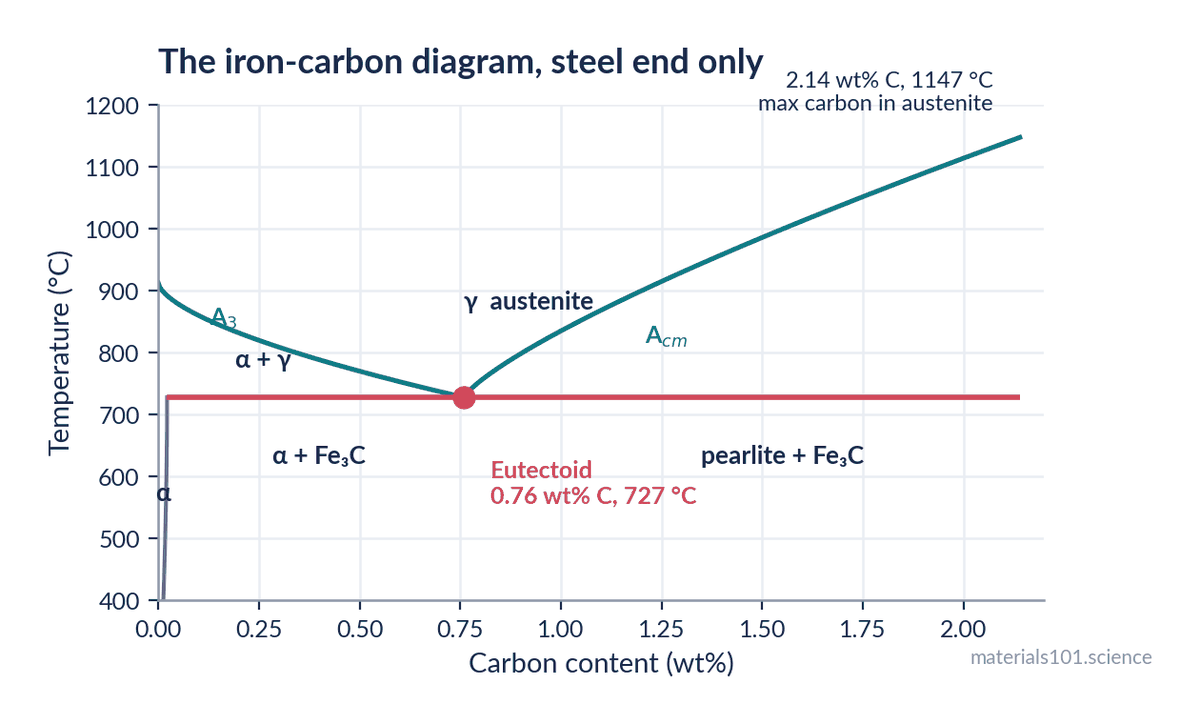
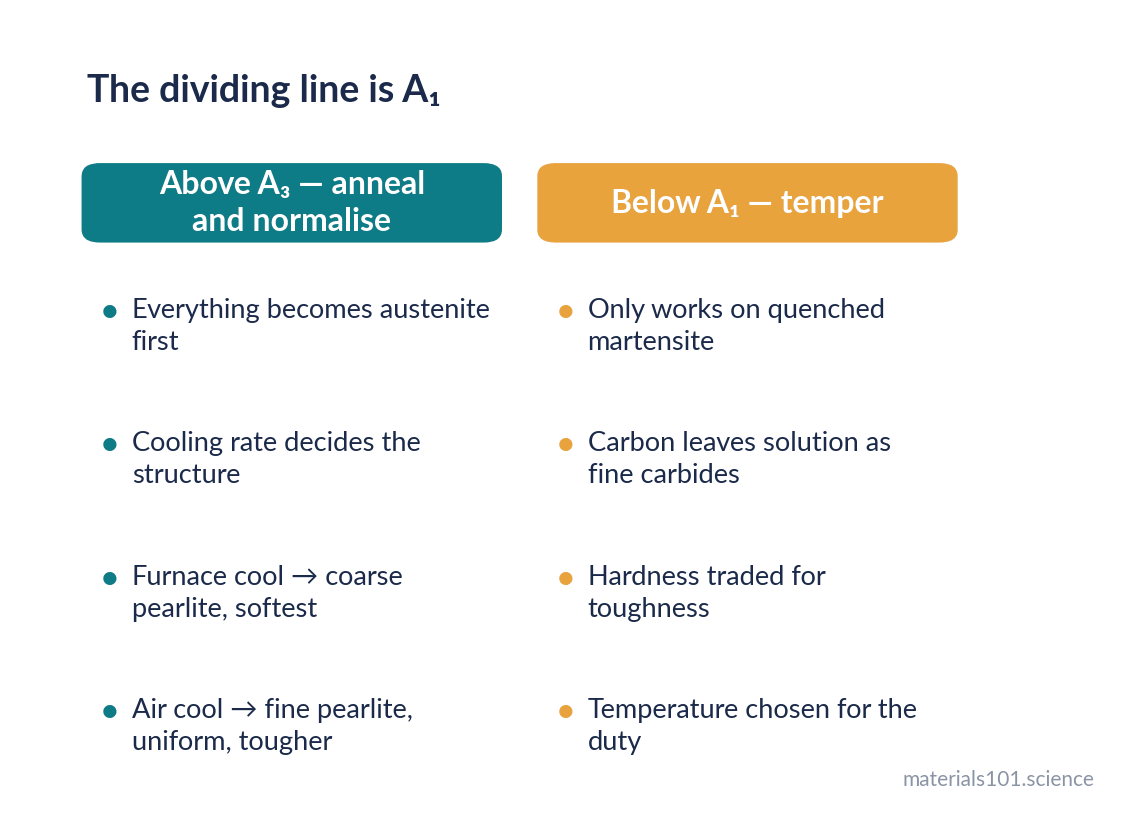
So “heat it above the critical temperature” means above A₃ for annealing and normalizing — you want everything to become austenite, which is the point: austenite dissolves the existing microstructure and gives you a clean slate. Tempering is the odd one out. It happens below A₁, deliberately, because it is not trying to re-austenitize anything.
What each treatment actually does
Annealing — make it soft and machinable
Heat to roughly 30–50 °C above A₃, hold long enough for the whole section to become austenite, then cool as slowly as you can — usually by switching the furnace off and leaving the part inside overnight.
Slow cooling gives carbon plenty of time to diffuse, so you get coarse pearlite: thick alternating lamellae of ferrite and cementite, with large ferrite grains. That is the softest and most ductile condition a plain carbon steel can be in. Hardness drops, machinability improves, internal stresses disappear, and any cold-worked structure is fully recrystallised.
You anneal when you need to do something to the part next: machine it, form it, or cold-work it again.
Normalizing — make it uniform and fine-grained
Heat to roughly 55 °C above A₃, hold, then cool in still air.
Air cooling is perhaps a hundred times faster than furnace cooling. Carbon has less time to diffuse, so the pearlite comes out finer and the ferrite grains smaller. Finer pearlite is harder and stronger than coarse pearlite, and finer grains are tougher — grain refinement being the rare lever that improves strength and toughness together.
Normalizing exists mainly to erase history. Castings solidify with dendritic segregation; forgings and welds end up with wildly different grain sizes in different places; hot-rolled bar has directional structure. Normalizing homogenizes all of it and leaves a predictable starting point for whatever comes next.
Tempering — give the hardness back some toughness
Tempering only makes sense on steel that has already been quenched to martensite. As-quenched martensite is extremely hard and almost unusably brittle: carbon trapped in a body-centred tetragonal lattice, with high residual stress and no tolerance for a notch.
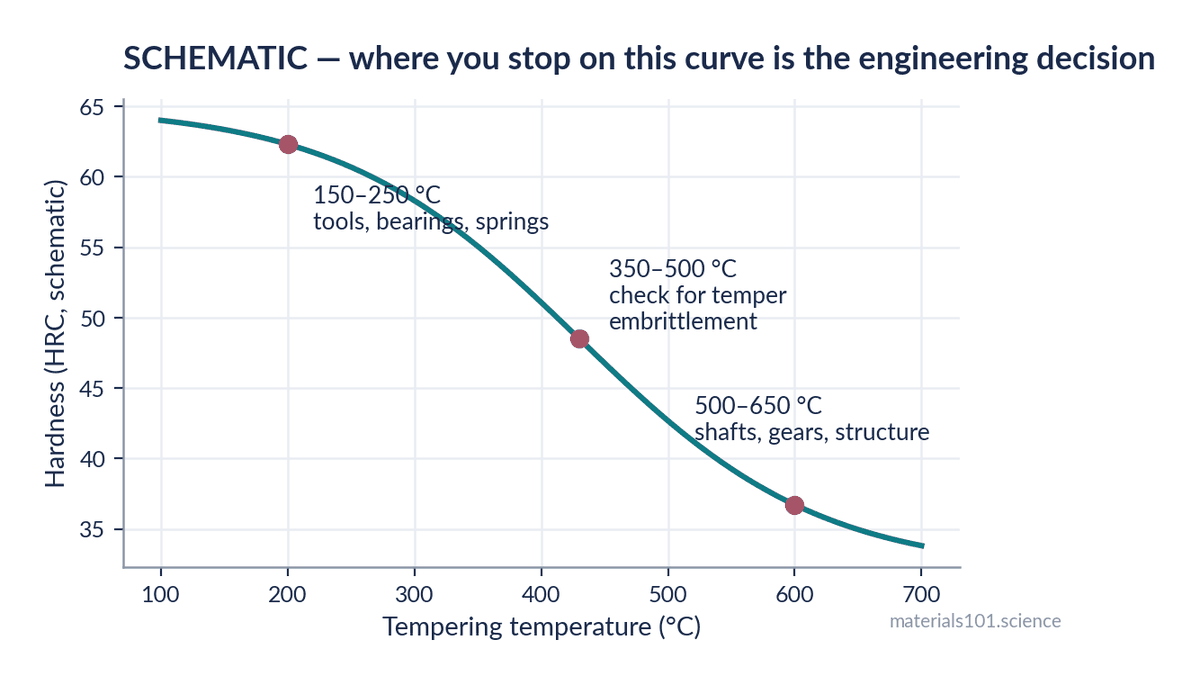
Reheat it to somewhere between 150 °C and 650 °C — below A₁ — hold, and cool. Carbon diffuses out of the supersaturated martensite and precipitates as fine carbides. Hardness falls, toughness rises, residual stress relaxes. Where you stop on that curve is the engineering decision.
- 150–250 °C — keeps most of the hardness, relieves the worst stress. Bearings, cutting tools, springs.
- 350–450 °C — a middle ground, but avoid this window in many steels: see temper embrittlement below.
- 500–650 °C — a large toughness gain for a real hardness loss. Structural components, shafts, gears.
The schedules, side by side
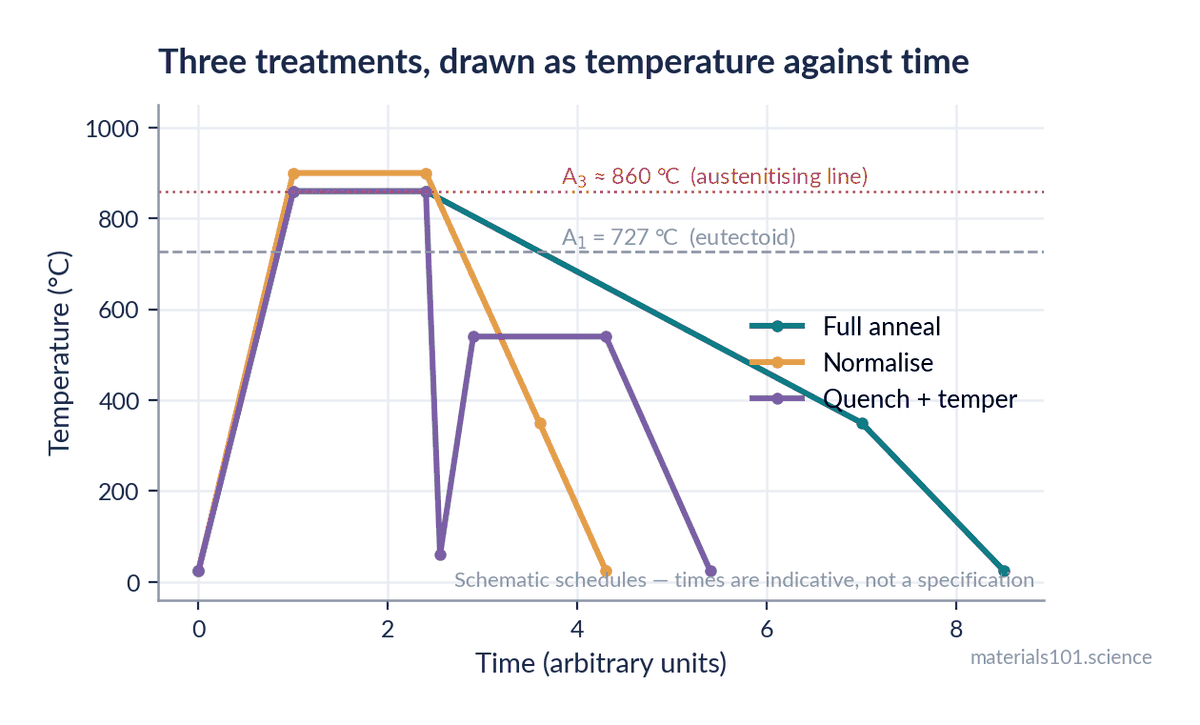
| Annealing | Normalizing | Tempering | |
|---|---|---|---|
| Temperature | A₃ + 30–50 °C | A₃ + 55 °C | 150–650 °C (below A₁) |
| Cooling | furnace, very slow | still air | air, from below A₁ |
| Prior condition needed | any | any | must be quenched |
| Microstructure produced | coarse pearlite, large ferrite grains | fine pearlite, fine ferrite grains | tempered martensite |
| Hardness | lowest | moderate | adjustable by temperature |
| Ductility | highest | good | good, and tunable |
| Residual stress | removed | low | substantially relieved |
| Typical purpose | soften for machining or forming | homogenize, refine grain | make a quenched part usable |
Going deeper
The reason slow cooling coarsens pearlite is diffusion distance. Pearlite grows as a cooperative front where carbon diffuses sideways from the forming ferrite into the forming cementite; the interlamellar spacing is set by how far carbon can travel before the front advances. Cool slowly and the front moves slowly, so carbon travels further and the lamellae are thick. Cool faster and the spacing shrinks, which is why fine pearlite is stronger — a Hall-Petch-like relationship applies to interlamellar spacing as well as to grain size [2]. Push the cooling rate far enough and the cooperative mechanism cannot keep up at all: you get bainite, and beyond that, martensite.
How to choose
| If the problem is | The treatment is | Because |
|---|---|---|
| “It is too hard to machine” | full anneal | coarse pearlite is the softest condition available |
| “The casting has inconsistent properties” | normalize | austenitizing dissolves segregation, air cooling gives a uniform fine structure |
| “The weld HAZ is hard and brittle” | normalize, or temper locally | both refine or soften the affected zone |
| “It shattered instead of bending” | temper (if quenched) | untempered martensite has almost no toughness |
| “It is strong enough but distorts in service” | stress relief below A₁ | you want the stress gone without changing the microstructure |
| “It needs to be hard on the surface, tough inside” | none of these — case harden | a surface treatment, not a bulk one |
Four mistakes worth avoiding
1. Tempering something that was never quenched. Reheating normalized steel to 550 °C does very little except relieve stress. There is no martensite to temper.
2. Tempering in the embrittlement window. Many alloy steels lose impact toughness if tempered around 350–500 °C — classically attributed to impurity segregation, especially phosphorus, to prior-austenite grain boundaries. The hardness curve looks fine; the Charpy result does not. Check the grade’s recommended tempering ranges rather than interpolating.
3. Overheating during austenitizing. Hold too hot or too long and the austenite grains grow, and every structure you form from them inherits that coarseness. You have then made the part weaker and less tough while doing a treatment intended to improve it.
4. Treating section thickness as irrelevant. A 100 mm shaft air-cooled is not normalized in the middle — its centre cools slowly enough to anneal. Cooling rate is a local quantity, and hardenability (the Jominy test exists for this) tells you how deep the treatment reaches.
In practice
Specify heat treatments by the outcome and the standard, not by the word alone: “normalize per ASTM A1033 practice, 900 °C ± 15 °C, still air, hardness 150–190 HB” is actionable, whereas “normalized” leaves your heat treater to guess a temperature that depends on carbon content they may not know. And always specify where hardness is to be measured — surface and mid-radius are different numbers on anything thick.
Where the other treatments fit
- Stress relief — below A₁, typically 550–650 °C, slow cool. Removes residual stress from welding or machining without changing the microstructure.
- Process anneal — below A₁, for cold-worked low-carbon sheet. Recrystallises the ferrite so you can keep drawing it, without the cost of a full austenitizing cycle.
- Spheroidizing — long hold just below A₁. Turns cementite lamellae into spheres, giving the softest, most machinable condition for high-carbon steels.
- Austempering — quench into a bath held above the martensite start temperature and hold isothermally. Produces bainite: nearly the strength of tempered martensite with better toughness and far less distortion, because you never pass through the martensite transformation.
Common misconceptions
- “Annealing always softens.” In steel, yes. In cold-worked copper or aluminium it also softens, but in some precipitation-hardening alloys a “solution anneal” is followed by ageing that makes the alloy considerably harder. The word describes the thermal cycle, not the outcome.
- “Normalizing is just a fast anneal.” The cooling rate difference changes which microstructure forms. Different structure, different properties, different purpose.
- “Higher tempering temperature is safer.” More ductile, yes, but you lose the strength you quenched for — and in the embrittlement window you can lose toughness too.
Key takeaways
- A₁ (727 °C) and A₃ (912 °C down to 727 °C with carbon) define every steel heat treatment; annealing and normalizing go above A₃, tempering stays below A₁.
- Annealing is furnace-cooled and gives coarse pearlite — the softest, most machinable state.
- Normalizing is air-cooled and gives fine pearlite and fine grains — uniform, stronger, tougher.
- Tempering only applies to quenched steel, and the temperature you choose is a direct trade of hardness for toughness.
- Section thickness changes the local cooling rate, so the same furnace cycle can anneal the centre of a part while normalizing its surface.
Frequently asked questions
What is the difference between annealing and normalizing?
Both heat the steel above A₃ to form austenite, but annealing cools it very slowly in the furnace while normalizing cools it in still air. Annealing gives coarse pearlite and the softest condition; normalizing gives finer pearlite and finer grains, so the steel ends up harder, stronger and more uniform.
Can you temper steel that has not been quenched?
Not meaningfully. Tempering works by decomposing martensite, which only forms on quenching. Reheating unquenched steel below A₁ relieves stress but does not change hardness much.
What temperature should I temper at?
It depends on the hardness you need. Roughly, 150–250 °C keeps most of the hardness for tools and bearings, and 500–650 °C gives a large toughness gain for structural parts. Check your grade’s datasheet, and avoid the 350–500 °C embrittlement window in alloy steels.
Does annealing remove residual stress?
Yes, completely — it is the most thorough stress relief available, because the steel is fully re-austenitized. If you only need the stress gone and want to keep the existing microstructure, a stress relief below A₁ is cheaper and causes less distortion.
Why does normalizing improve toughness?
It refines both the ferrite grain size and the pearlite interlamellar spacing. Finer grains raise strength and lower the ductile-to-brittle transition temperature at the same time, which is unusual among strengthening mechanisms.
Next read
- BCC vs FCC vs HCP: why crystal structure decides ductility — why the ferrite in all of this behaves the way it does
- The Liberty ships that broke in half — what happens when toughness is left out of the specification
References
Figure 2 uses the standard invariant points of the Fe-C system; the tempering
figure is a labelled schematic, because a real hardness-versus-tempering curve is
grade-specific and belongs to the steel’s own datasheet.
- W. D. Callister and D. G. Rethwisch, Materials Science and Engineering: An Introduction, 10th ed., Wiley, 2018 — Fe-C invariant points, pearlite formation, annealing and normalizing practice.
- G. Krauss, Steels: Processing, Structure, and Performance, 2nd ed., ASM International, 2015 — pearlite interlamellar spacing and strength, austenitizing practice, tempering reactions.
- ASM International, ASM Handbook, Volume 4A: Steel Heat Treating Fundamentals and Processes, 2013 — process windows, temper embrittlement, section-size effects.
Written by Dinesh Varma, PhD scholar in computational materials science.
Spotted an error? Tell me — corrections are credited.