

On 16 January 1943, the tanker Schenectady was moored at her fitting-out dock in Portland, Oregon. She had completed sea trials the day before. The water was calm, the ship was empty, and the air was cold.
She cracked with a report heard a mile away. The fracture ran up from the bottom of the hull, through the deck, and across to the other side. The hull was left hanging on its bottom plating, the middle of the ship rising clear of the water while the bow and stern settled.
Nobody had loaded her. Nobody had hit her. The steel had met specification.
By the end of this post you will understand exactly what went wrong — and why the fix required inventing a whole field of engineering.
In this post:
- What actually happened to the wartime fleet
- Three decisions that were each reasonable alone
- The temperature nobody had thought to specify
- How Constance Tipper found it
- What every engineer inherited from it
What actually happened
The United States built about 2,700 Liberty ships between 1941 and 1945 — cargo vessels produced faster than any merchant fleet in history, some launched within weeks of keel-laying. They were welded rather than riveted, prefabricated in sections, and built by a workforce that had mostly never touched a shipyard before.
They also cracked. The figures usually quoted are roughly 1,500 ships with significant hull fractures and about a dozen that broke completely in two. Not in hurricanes. Several failed at anchor, in port, in calm water. What they shared was cold: North Atlantic winters, Alaskan waters, a January morning in Oregon.
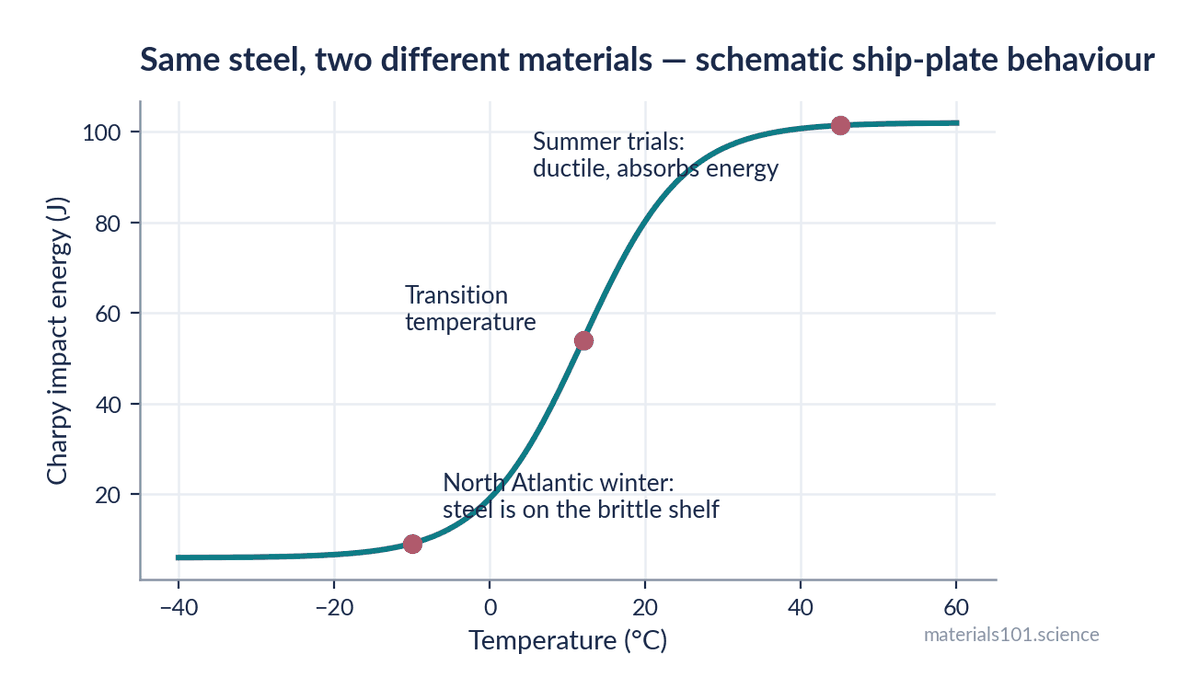
That pattern is the clue. A structure that fails in the cold and survives the same load when warm has not been overloaded. Something about the material changed with temperature.
Three decisions, each reasonable alone
Welding replaced riveting
Riveted ships are built from overlapping plates joined by thousands of separate fasteners. Welded ships are, mechanically speaking, one continuous piece of steel. Welding was faster, cheaper, lighter and it needed less skilled labour — in 1941, all four arguments were decisive.
But a riveted hull has a property nobody had thought to value: a crack that starts in one plate runs to the edge of that plate and stops. The joint is a discontinuity, and a discontinuity is a crack arrester. In a welded hull, there is nothing to stop it. A crack that starts anywhere can, in principle, travel the entire length of the ship — and in the worst cases it did, at speeds approaching a kilometre per second.
Square hatch corners
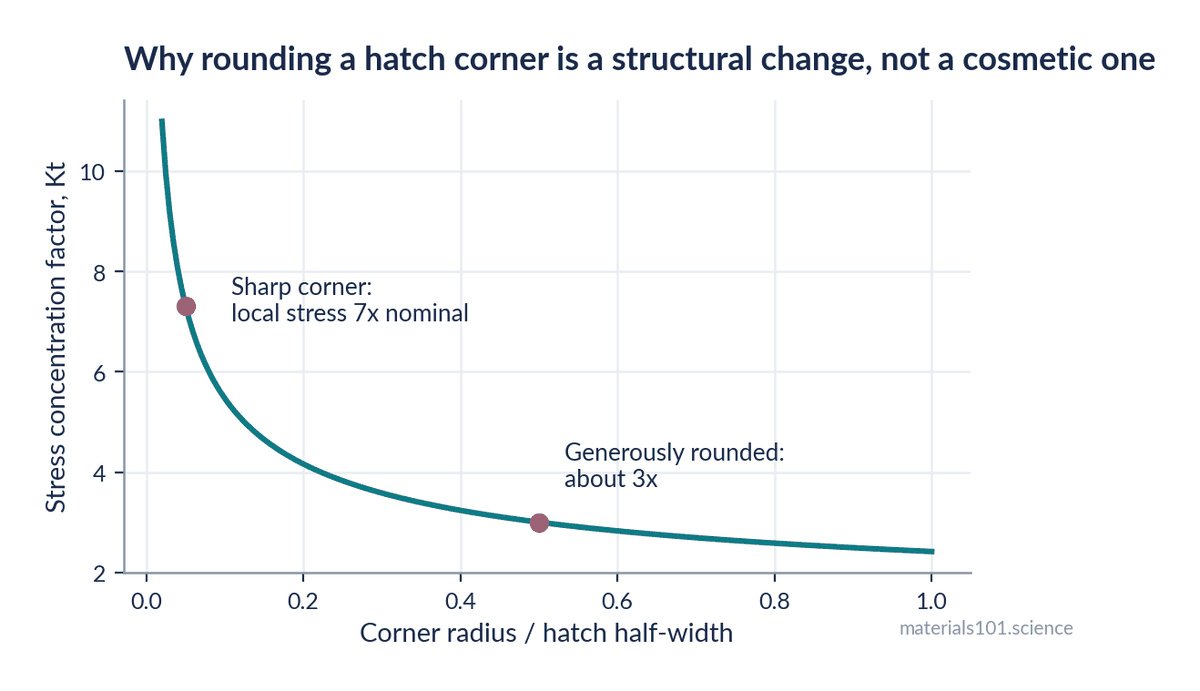
A cargo hatch is a large rectangular hole in the deck — which is to say, in the part of the hull carrying the most tension when a ship hogs over a wave. The Liberty ships had square hatch corners, because square is what you draw.
A sharp corner concentrates stress. The elastic solution for an elliptical hole gives a stress concentration factor of 1 + 2a/b, so as the corner radius shrinks the local stress climbs steeply — a factor of three or four is easy, and more at a genuinely sharp notch. Analyses of the wartime failures found that a majority of the serious fractures started at hatch corners.
Steel that met the specification
The specification of the day set chemistry limits and tensile strength. The steels used were often relatively high in carbon and sulfur, low in manganese, and coarse-grained — all of which raise the temperature at which the steel loses its toughness. They passed every test the specification required, because the specification did not test the property that mattered.
Going deeper
The metallurgy is the ductile-to-brittle transition, and it exists because ship plate is a body-centred cubic metal. In BCC iron, moving a dislocation requires help from thermal vibration, so the yield stress rises steeply as temperature falls. The stress needed to propagate a cleavage crack barely changes. Below the temperature where those two curves cross, the crystal finds it easier to split along {100} planes than to shear — and the failure is fast and absorbs almost no energy. Face-centred cubic metals such as austenitic stainless steel have no such crossing point, which is why they are the standard for cryogenic service. The lever arms available to a metallurgist are grain refinement (lowers the transition temperature substantially), a higher manganese-to-carbon ratio, aluminium-killed fine-grain practice, and lower sulfur and phosphorus.
The temperature nobody had specified
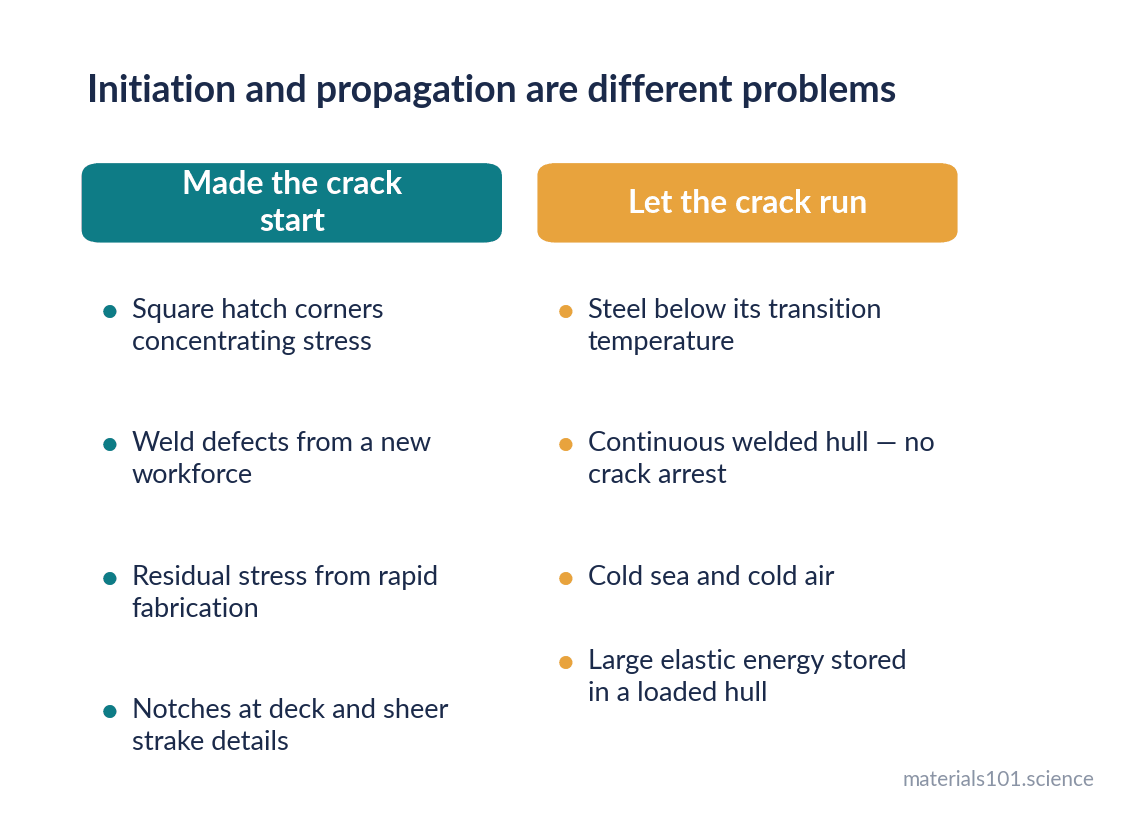
Put the three decisions together and you have a machine for producing catastrophic failure.
A weld defect or a hatch corner supplies the initial crack. The steel is below its transition temperature, so it cannot blunt that crack by yielding. The hull is a continuous welded structure, so once the crack starts moving there is nothing in its path. The energy stored elastically in a loaded hull is more than enough to keep a brittle crack running.
The lesson is that no single decision was wrong. Welding was right. Prefabrication was right. The steel met its specification. What was missing was the recognition that a structure has a temperature below which its material behaves like a different material, and that this temperature has to be a design requirement like any other.
How Constance Tipper found it
The investigations ran on both sides of the Atlantic, and the piece of work most often credited with settling the question came from Constance Tipper at Cambridge.
Tipper’s contribution was to demonstrate systematically that the ship plate steels had a transition temperature within the range of ordinary service — that above it they tore in a ductile manner and below it they cleaved — and to develop a test that made the transition visible and measurable. The failures were not, as had been widely assumed, primarily a problem of bad welding by an inexperienced workforce. Poor welds supplied starting points, but the steel itself was the reason a starting point became a lost ship.
It is worth sitting with the fact that this was not obvious at the time. The prevailing view blamed workmanship, which is the comfortable answer — it makes the failure somebody’s fault rather than a gap in everyone’s understanding. Tipper’s answer was harder and correct.
What every engineer inherited
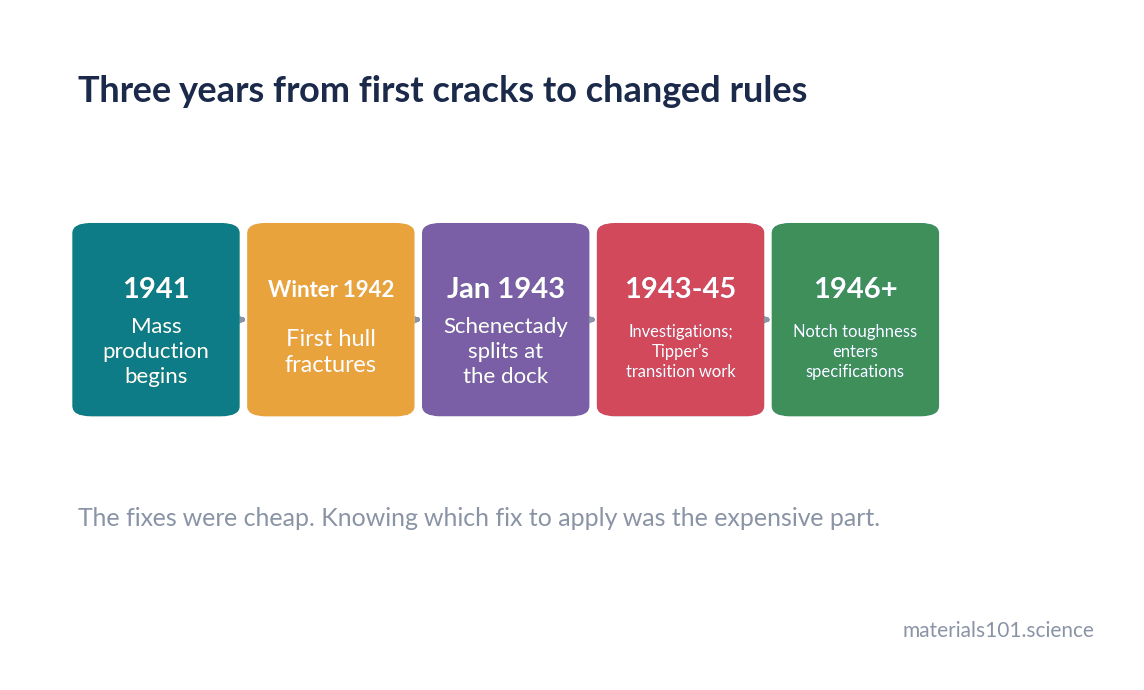
The fixes were unglamorous and effective. Hatch corners were rounded. Riveted crack-arrester strakes were deliberately added back into welded hulls — a discontinuity reintroduced on purpose, to stop a running crack. Steel specifications began to require notch toughness at a stated temperature, rather than strength at room temperature alone. Grain-refined, aluminium-killed steels with better manganese-to-carbon ratios became standard for structural use.
In practice
That inheritance is why Charpy V-notch testing (ASTM E23) sits in modern structural, pipeline and pressure-vessel specifications, and why those specifications quote impact energy at a stated temperature — 27 J at −20 °C, for example — rather than tensile strength alone. If you are specifying steel for anything that will get cold, “the steel is strong enough” is not an answer. The question is whether it is still tough at the lowest temperature it will ever see, at the highest loading rate it will ever see, with the thickest section you intend to use. All three matter, and the third surprises people: thicker sections constrain the material into plane strain, which raises the effective transition temperature.
The deeper inheritance is fracture mechanics itself. The wartime failures made it unavoidable to treat cracks as objects with their own mechanics — with a driving force, a resistance, and a critical size — rather than as defects to be eliminated. Griffith had laid the groundwork in the 1920s; the ship failures made the field urgent, and the work that followed produced the stress intensity factor and the damage-tolerant design philosophy that aircraft, pressure vessels and pipelines are built on today.
Common misconceptions
- “The Liberty ships were badly built.” They were built fast, by inexperienced workers, and welding quality varied. But the reason a crack became a catastrophe was the steel’s transition temperature, not the welder’s skill.
- “Modern steels don’t have this problem.” Modern structural steels have much lower transition temperatures, and specifications now test for it. The physics has not changed: any BCC steel has a transition temperature somewhere, and cold, thick and fast-loaded is still the dangerous combination.
- “The Schenectady was a Liberty ship.” She was a T2 tanker, built at the same yard complex under the same wartime programme, and she suffered the same failure for the same reasons. The story is usually told together because the metallurgy is identical.
Key takeaways
- About 2,700 Liberty ships were built; roughly 1,500 developed significant hull fractures and about a dozen broke in two, disproportionately in cold water.
- Three individually reasonable decisions combined lethally: continuous welded hulls with no crack arrest, square hatch corners concentrating stress, and steel with a ductile-to-brittle transition inside the service temperature range.
- The transition exists because ship plate is BCC iron, whose yield stress climbs steeply as temperature falls while its cleavage stress does not.
- Constance Tipper showed the steel, not the welding, was the root cause — the harder and less comfortable explanation.
- The fixes — rounded corners, crack arresters, notch-toughness requirements — and the field of fracture mechanics are what every structural engineer inherited from it.
Frequently asked questions
Why did the Liberty ships crack?
Their steel had a ductile-to-brittle transition temperature inside the range of normal service, so in cold water it fractured without absorbing energy. Square hatch corners concentrated stress and provided crack starting points, and the continuously welded hull gave a crack nothing to stop it once it started running.
What is the ductile-to-brittle transition temperature?
It is the temperature below which a metal fails by cleavage instead of by plastic deformation, absorbing far less energy in the process. It affects body-centred cubic metals such as ferritic steels, and it is measured with a notched impact test such as Charpy V-notch.
Why don’t riveted ships fail the same way?
A riveted hull is made of separate overlapping plates, so a crack running through one plate reaches a joint and stops. A welded hull is structurally continuous, so a crack can propagate through the whole structure. Riveted crack-arrester strakes were later added back into welded ships for exactly this reason.
Who was Constance Tipper?
A metallurgist at Cambridge whose work on the wartime hull failures demonstrated that the ship plate steel had a transition temperature within service conditions, shifting the explanation from poor welding to the material itself. The Tipper test is named after her.
Could this happen today?
The specific failure is guarded against by notch-toughness requirements in modern steel specifications, but the physics is unchanged. Cold service temperatures, thick sections, high loading rates and sharp geometric details remain the combination to watch — which is why they appear together in every structural code.
Next read
- BCC vs FCC vs HCP: why crystal structure decides ductility — the physics under this story
- Reading the iron-carbon phase diagram in 10 minutes — how investigators tell them apart
- Annealing vs normalizing vs tempering — the other way structures fail without being overloaded
References
- The Mariners’ Museum and Park, Brittle Fracture: When Ships Split in Two
- Technical Problem Identification for the Failures of the Liberty Ships, Challenges, MDPI 2016
Written by Dinesh Varma, PhD scholar in computational materials science.
Spotted an error? Tell me — corrections are credited.